|
|
|
Military
Family
Deployment
Guide
Benefits
sponsored
by

Extended
deployments
and
separation
from
your
loved
ones can
be
especially
trying
and
challenging.
As your
children
grow up
and they
are
influenced
by media
and peer
pressures,
they
receive
mixed
messages,
making
their
transition
from
childhood
to
adulthood
especially
difficult.
To help
reinforce
a
positive
self
image,
you can
become
directly
involved
in
helping
your
children
overcome
these
hardships.
The Dove
Self
Esteem
Fund
provides
you guidance
on how
to help
your
children
incorporate
these
mentoring
ideas in
their
development.

Whether
you're a
parent,
guardian,
sports
coach or
mentor,
you can
make a
positive
difference
to the
young
people
in your
life.
The
following
are some
ideas
and
suggestions
you can
use in
fostering
healthy
self-esteem
in young
girls:

|
Teach
children
that
their
self-worth
is
not
related
to
how
they
look.
Emphasize
their
talents
and
qualities.
Don't
focus
on
their
physical
appearance.
|

|
Talk
with
your
children
about
self-esteem,
body
image
and
what
it
means
to
be
beautiful.
The
downloadable True
You!
Guide
can
help
you
to
open
up
a
dialogue
with
your
children.
|
|

Be
a
healthy
role
model
for
your
children
-
Don't
make
comments
about
anyone's
size
or
weight,
especially
as
a
"joke".
-
Make
sure
that
your
child
knows
that
you
love
them
regardless
of
their
size
or
weight.
-
Treat
fat
and
thin,
tall
and
short,
dark
and
fair
(etc.)
children
the
same.
-
Build
self-confidence
and
self-esteem
through
a
range
of
activities,
both
physical
and
non-physical.
-
Build
good
self-esteem
in
all
children
for
who
they
are
and
what
they
do,
not
how
they
look.
-
Feel
proud
of
your
child,
regardless
of
their
size
or
weight.
-
Be
creative
and
assertive
in
finding
the
right
clothing
and
equipment
for
your
child.
-
Encourage
healthy
eating
and
physical
activity
for
the
entire
family.
-
Don't
feel
guilty
or
ashamed
if
you
or
your
child is
fat.
|
|

|
Be
aware
of
advertising
and
toys
aimed
at
children.
Notice
how
they
reinforce
gender
stereotypes
and
body
dissatisfaction.
Encourage
a
conversation
about
how
the
child
in
your
care
views
the
advertisement
or
the
toy.
Foster
critical
thinking...
and
playfulness.
|
|

|
Work
toward
identifying
and
resisting
all
forms
of
discrimination.
Remember
that
prejudice
against
size
and
body
relates
to
prejudice
based
on
sex,
race,
sexuality,
class
and
physical
ability.
|
Choose
from a
variety
of
high-quality
diapers
at low
prices -
for
babies
and
adults.
www.discountdiapersdirect.com
Volunteer
Blazes
New Path
With
Passion
for
Troops
By
Fred W.
Baker
III
American
Forces
Press
Service
|
|
WASHINGTON,
Feb.
2007 –
When it
comes to
connecting
troops
and
their
families
with
services
they
deserve,
Pat Kerr
is in a
league
of her
own --
literally.
|

Missouri
State
Veterans
Ombudsman
Pat
Kerr
shows
off
a
photo
of
her
daughter,
Army
Reserve
Capt.
Kate
Numerick,
who
is
serving
her
second
tour
in
Iraq.
|
|
As the
only
paid
state
veterans
ombudsman
in the
nation,
Kerr
spends
her time
battling
bureaucracies,
raising
money
and
advocating
for
servicemembers,
their
families
and
veterans
in
Missouri.
But
folks
shouldn’t
let the
salary
fool
them;
Kerr’s
passion
for
taking
care of
troops
began
long
before
her
tenure
at the
Missouri
State
Veteran’s
Commission.
It
started
at home,
right
after
the
start of
Operation
Iraqi
Freedom.
Kerr’s
daughter,
an Army
Reserve
officer,
was
deployed
two
weeks
after
the war
in Iraq
started
in March
2003.
The care
for the
soldier’s
13-month-old
son fell
to Kerr.
This
came as
Kerr was
also
caring
for her
husband,
who was
dealing
with
serious
medical
issues.
Even
though
Kerr and
her
family
members
thought
they was
ready,
Kerr
said,
they
quickly
realized
they
were
not.
“She
kind of
looked
like a
deer in
the
headlights
with her
notice,”
Kerr
said of
her
daughter.
“Even
though
after
9/11 we
sat as a
family
and made
a plan.
We knew
she
would
get
deployed.
“We
were
shocked,”
Kerr
said.
Kerr’s
husband
is a
pastor
and a
licensed
professional
counselor.
Her
daughter
is
educated
and
working
on her
doctorate
degree.
Kerr was
trained
on
coping
skills
while
dealing
with her
husband’s
near
fatal
injuries
following
a
serious
accident.
With all
of the
education
and
training
in her
family,
Kerr
said,
she
realized
that if
she had
difficulties,
so would
many
others.
“We
decided
that if
we, who
had
trained
coping
skills,
… are
a little
overwhelmed
by
what’s
coming
down the
pike,
what’s
going to
happen
to our
Guard
and
reserve
(members)
who
don’t
have our
professional
background,”
Kerr
said.
So, two
weeks
after
her
daughter
left,
Kerr
began
organizing
events
like
“Support
Your
Troops”
at the
state
Capitol.
Working
nights
as a
secretary
and
dipping
into
savings
from her
court
reporting
business,
Kerr
paid for
many of
the
expenses
herself.
The
events
drew
thousands,
and
state
officials
began
looking
to Kerr
to help
set up
similar
events
and
soliciting
her
input on
the
development
of
troop-related
programs.
Kerr
also
started
advocating
on
behalf
of
troops
who were
stuck in
the gaps
between
the
local,
state
and
federal
systems.
At that
time
most of
problems
troops
were
facing
were not
well
known,
she
said.
“We
started
talking
about
the gaps
in the
system.
And
people
would
say
‘What
gaps?’
So I
would
use real
examples,”
Kerr
said.
“What
about
the guy
who lost
his eye
in
Ramadi?”
she
asked.
“The
soldier
has
three
children,
and his
wife
wants to
come
back to
Walter
Reed
(Army
Medical
Center
here)
with
him.
“Who’s
going to
pay for
his
child
care
seven
days a
week, 24
hours a
day?
Even if
they
have it
in
savings,
why
should
they
have to
pay for
it?”
Kerr
said.
Eventually
Kerr was
brought
on board
the
state-run
Missouri
Veterans
Commission
with the
mission
to raise
awareness
of the
commission
and to
identify
gaps in
the
systems.
That led
to the
Missouri
legislature,
the
governor,
the
Missouri
Veterans
Commission,
and the
Missouri
Association
of
Veterans
Organizations
formalizing
her
position
as state
veterans
ombudsman.
Since
taking
the
post,
Kerr has
coordinated
more
than
$600,000
for
servicemembers,
families
and
veterans
through
private
citizens,
corporations
or
veterans
service
organizations.
Her
efforts
have
kept 16
homes
from
being
foreclosed
on.
Kerr has
helped a
brain-injured
soldier
who was
stuck in
a
hospital
bed for
three
months
without
his
family.
A
clerical
error
made it
impossible
for
officials
to
locate
his
family,
and his
brain
injury
kept him
from
helping.
Kerr
reunited
him with
his
family,
who was
only 30
miles
away.
She
worked
with the
family
members
to get
the
soldier’s
disability
rating
raised.
Kerr
arranged
services
for a
mother
of four
children
-- three
in
diapers
-- who
broke
both of
her arms
while
her
husband
was
deployed–.
Kerr
arranged
for
24-hour
care
helping
the
mother
with
cooking,
cleaning,
diaper
changing
and
getting
the
children
to
school
while
she
healed.
There
was also
the
Korean
War
prisoner
of war
who
hadn’t
received
a penny
of the
benefits
coming
to him.
He
didn’t
even
know he
was
eligible
until
she
began
her
outreach
program
and a
family
member
asked
about
his
health
care.
Kerr’s
service
has even
rubbed
off on
her
grandson,
Abraham,
3.
While
caring
for her
grandson
as his
mother
served
in Iraq,
Abraham
regularly
accompanied
Kerr to
visit
injured
troops.
One day
when
planning
to
attend a
movie,
Abraham
had 11
cents in
his
hand.
Kerr
told him
to put
the
money in
his
pocket,
but
instead
he
offered
it up as
a
donation.
“He
said,
‘No
Grandma
– you
give
this to
your
injured
troops,’”
Kerr
said.
“I was
overwhelmed,”
she
added.
Kerr
took the
idea to
the
Missouri
Veterans
Commission
and the
lieutenant
governor
and
parlayed
it into
a school
education
campaign.
Dubbed
“The
Power of
11
Cents,”
the
program
focuses
on
educating
children
on
patriotism
and
America.
Kerr
said she
wanted
to allow
the
children
to help
support
the
troops
but not
focus
the
campaign
on the
war.
Originally
started
on
Veterans
Day, the
program
encourages
younger
children
to
donate
11 cents
and
older
students
donate
$1.11.
Abraham’s
act of
selflessness
led to
the
creation
of a
statewide
school
outreach
program
that
Kerr
hopes
will
raise
$50,000
for the
state
military
family
relief
fund.
Guard
and
reserve
troops
can
apply
for
$1,000
grants
from the
fund.
Kerr’s
daughter
is now
on her
second
tour to
Iraq,
and Kerr
is again
caring
for
Abraham.
Her
personal
experiences
help
Kerr
empathize
with
those
she
helps.
“I
know
these
issues.
I’ve
lived
these
issues.
I know
what
these
families
are
talking
about,”
Kerr
said.
Kerr’s
daughter
will
have
served
two
rotations
in Iraq
before
her son
turns 5
years
old. She
has
missed
many of
the
firsts
in a
child’s
life
that
most
mothers
cherish.
But, in
spite of
the
sacrifices
and the
inherent
dangers,
Kerr
said she
supports
her
daughter’s
decision
to
serve.
“I am
extremely
proud of
her. I
am
extremely
supportive
of what
her
commitment
is to
our
country,
and I am
forever
grateful,”
Kerr
said.
“Because
I am not
a brave
person
to go
out and
do what
she is
doing, I
can only
do what
I am
doing."
As the
list of
those
she
helps
gets
longer,
Kerr is
quickly
becoming
in
demand
across
the
nation.
Even
though
her
primary
focus is
on those
with
residence
in
Missouri,
Kerr
said she
fields
calls
from all
over the
nation
asking
for
help.
It’s a
job Kerr
describes
as
“way
cool”
and one
she has
no plans
to quit,
even
after
her
daughter
comes
home or
the war
is over.
“I am
probably
going to
do this
forever.
This is
not
going to
go away.
We are
going to
be
dealing
(with
veterans
issues)
for my
lifetime,”
Kerr
said.
“I’m
going to
support
our
troops.
I’m
going to
teach
our
veterans
and
reach
out to
the
families
of those
who have
injuries,”
she
said.
It is a
higher
calling
that
everyone
and
every
community
must
answer
if
Americans
are to
live
free,
Kerr
said.
“By
relying
on our
citizen
soldiers,
…
(supporting
them)
becomes
a great
onus on
the
state
and
employers
and
schools
and
civic
organizations
and
churches,”
Kerr
said.
“We
have to
work
together
as the
United
States
of
America.
We truly
have to
be
united
in order
to
accomplish
protecting
the
borders
of
America.”
Editors
Note:
While
Kerr is
the only
state
veterans
ombudsman
with a
state
veterans
commission,
servicemembers
and
veterans
can
contact
veterans
commissions
in their
home
states
to
inquire
about
state
benefits
by going
to the
Web site
of the
National
Association
of State
Directors
of
Veterans
Affairs
at
http://www.nasdva.com/.
Military
families
can also
avail
themselves
of the
Defense
Department's
America
Supports
You
program,
which
highlights
home
front
groups
across
the
nation
that are
providing
a
variety
of
services
and
support
to
troops
and
their
families.
A
listing
of these
groups
and
information
about
their
efforts
is
available
at
www.AmericaSupportsYou.mil.
|
|
|
|
 |
Missouri
State
Veterans
Ombudsman
Pat Kerr
with her
daughter,
Army
Reserve
Capt.
Kate
Numerick,
at a
change
of
command
ceremony.
Courtesy
photo
|
 |
Missouri
State
Veterans
Ombudsman
Pat Kerr
with her
daughter,
Army
Reserve
Capt.
Kate
Numerick,
at a
Support
Your
Troops
event at
Jefferson
City,
Mo.
Courtesy
photo
|
|
DoD
Committed to Taking
Care of Military
Families
By
Jim Garamone
American Forces Press
Service
|
|
WASHINGTON,
Nov. 2006 – The one
overriding lesson of
the all-volunteer
force is the
importance of the
military family, a top
Defense Department
official said here
today.
And
DoD has learned the
lesson, Michael
Dominguez, principal
deputy undersecretary
of defense for
personnel and
readiness, told the
Pentagon Channel and
American Forces Press
Service.
November is Military
Family Month, and
Dominguez said it is a
good time to highlight
the sacrifices and
strides military
families have made.
“Military families
make an enormous
contribution, because
they support the
servicemembers in the
work they have to
do,” he said.
With 150,000
servicemembers
deployed to Iraq and
another 20,000 in
Afghanistan, these are
tough times for
military families.
There were growing
pains as DoD attempted
to connect with
families, Dominguez
acknowledged.
“Clearly, our
ability to support a
deployed force at war
for sustained
operation needed to
adapt,” he said. The
department had never
faced a deployment
like Operations
Enduring Freedom or
Iraqi Freedom before.
The scale and length
made caring for
families difficult.
But the systems inside
the department are
adapting, he said.
“When a unit gets
deployed, the DoD
Education Activity
school surges
counselors,” he
said. The schools
understand what the
children are going
through and the
counselors help
prepare the teachers
and families for what
lies ahead.
“When the unit
redeploys, you get the
same kind of
pressures,” he said.
“These
servicemembers are
coming home and life
is going to change
again. They are going
to be dealing with all
kinds of issues from
having been in
combat.” Other
questions surface,
such as how the
children are going to
react to Dad or Mom
coming home. The
spouse has forged
something of an
independent identity
during the deployment.
How will the spouse
react?
“Again, (we have a)
big surge; a pulse of
support to make sure
the community can deal
with that and that the
schools and teachers
are ready for that and
prepared to help
families,” Dominguez
said.
He said he has seen
the department grow
and develop, but more
needs to happen.
“This conflict is
going to stretch
us,” he said.
“We’re going to
bump into some
boundaries we didn’t
know were there. So
there’s going to be
more room for
improvement, for
growth more
development that
we’re going to have
to make, but I’m
confident that we will
adapt to it, because
families are
important. They
sustain the
all-volunteer
force.”
Some servicemembers
have made multiple
deployments to war
zones, and Dominguez
said it never gets any
easier. “I can’t
imagine it gets easier
-- not for the
families, not for the
member,” he said.
“I’d have to
speculate it gets
harder each time, but
you’d have to ask
one of our heroes
who’ve done it, and
one of those marvelous
families that support
them in doing it.”
Information on how to
help military families
is available at the
Defense Department’s
“America Supports
You” Web site,
www.americasupportsyou.mil.
|
|
Biographies:
Michael
Dominguez
Related Sites:
America
Supports You
|
America
Supports You: USA Cares Gets $2.5
Million Boost
By
Samantha L. Quigley
American Forces Press Service
|
|
WASHINGTON,
Sept. 2006 – USA Cares
recently received a $2.5 million
grant to further its mission of
assisting servicemembers and their
families, organization officials
said.
“I
can’t explain how happy we are
about it. We’re just beyond
thrilled,” Barbara Yaw, USA
Cares’ director of communications,
said. “We’re very blessed.”
The grant came from the Iraq
Afghanistan Deployment Impact Fund
administered by the California
Community Foundation. The foundation
is a leading charitable organization
in Los Angeles County, managing over
$1 billion in assets.
The California Community Foundation
surprised the Radcliff, Ky.,
organization last year as well, Yaw
said.
“It was actually a surprise for
us, the last week of December 2005,
to open up this plain envelope and
see $1 million donation sitting
there,” she said. “It seemed
every day to them, and it was an
amazing, shocking thing for us here
in the office.”
Wise use of that $1 million earned
the nonprofit organization an
invitation to apply for the larger
grant, Yaw said. The long
application process concluded two
weeks ago, when USA Cares got the
phone call that its request for the
two-year grant had been approved.
USA Cares helps bridge financial
gaps for families of servicemembers
deployed anywhere in support of
operations in Iraq or Afghanistan,
Yaw said. The majority of the
nonprofit organization’s
assistance relates to
quality-of-life issues.
“If we have an issue where
there’s been a financial mistake
by the military, and … that
sometimes happens, we would provide
monies directly to the service
provider for electric to keep the
electric going (for example.),”
she said.
USA Cares is a member of America
Supports You, a Defense Department
program highlighting ways Americans
and the corporate sector support the
nation’s servicemembers.
Currently eligible families can
receive up to $750 in assistance for
family needs, including food,
diapers, formula, electricity and
rent, Yaw said. If there’s an
additional need, the case is
re-evaluated. Two grants is the
absolute maximum, however.
If the need is larger than USA Cares
can handle on its own, it routinely
partners with other organizations
that might be able to help the
family, she said.
When it comes to mortgages, USA
Cares can offer a maximum of $7,500
in assistance to homeowners, Yaw
said. Because of the grant, however,
the organization is looking at its
process to see what adjustments and
allowances can be made for the
mortgage assistance portion of its
program.
“We have also partnered with an
organization called (Homeownership)
Preservation Foundation, and we have
saved over 80 military families’
homes from foreclosure,” she said.
The assistance USA Cares offers is
always in the form of a grant and
does not discriminate, she said.
“If you’re a military family, we
support you,” she said, adding
that the organization has granted
nearly $1.7 million since its
founding in March 2003.
In accepting the $2.5 million grant,
USA Cares agreed to file reports on
how the money was being spent,
something Yaw said was not an issue
for the group. “We’re hovering
somewhere around 97 cents on the
dollar going back to military
families and servicemembers, and
we’re working very hard to move
that up to 100 percent,” she said.
“We feel very, very secure in the
fact that we’re responsible with
every penny,” she said.
|
|
|
Related Sites:
USA Cares
California
Community Foundation
America
Supports You
|
Programs
Help Prepare, Support Families Through Deployments
By Donna Miles
American Forces Press Service
|
|
MARINE CORPS BASE
CAMP PENDLETON, Calif., Aug.2006 – As members of
the 15th Marine Expeditionary Unit here make
last-minute preparations for their upcoming
deployment, Staff Sgt. Danny Sava and his family
are getting their own affairs in order so
they’re ready for another long separation.
|
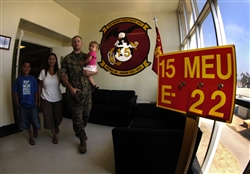
Marine Staff Sgt. Danny Sava, his
wife, Julia, son, Anthony, and
daughter, Alyssa, stroll past a
sign at the top of a stairwell in
the 15th Marine Expeditionary
Unit’s command headquarters that
marks the days until Sava’s
upcoming deployment. “E-22”
marks “Embarkation minus 22,”
or 22 days until Sava and 2,300
fellow Camp Pendleton Marines will
deploy, leaving their families
behind in the care of the base’s
extensive family support network.
Photo by Cherie Thurlby
|
|
The Sava family —
Danny, a seven-year Marine, his wife of two years,
Julia, and their children, Anthony, 10, and
Alyssa, 18 months — offer insights into what a
“typical” military family faces during
deployments and the importance of the services the
military provides to help them.
Less than three weeks before Danny and 2,300
fellow Marines leave here for six months of duty
as U.S. Central Command’s theater reserve, the
Savas told American Forces Press Service they’ve
got a handle on their family affairs.
Sava, the 15th MEU’s data chief, is drawing up a
list of details and contact information for Julia.
The family bill-payer, he set up automatic online
payments and is making sure she knows where to
find his will, power of attorney, Social Security
card and other important documents. “We’re
trying our best to get everything together and get
squared away,” Julia said.
The Savas already have endured one deployment as a
family — when Danny was in Iraq and Julia was
experiencing a difficult pregnancy until
Alyssa’s birth two months before her daddy’s
homecoming. The family lived off base during the
last deployment, and Julia’s doctor warned her
not to drive. Fortunately, her parents didn’t
live far away and were able to pitch in when she
needed it. “That’s what kept me going,” she
said.
Danny made his presence felt at home the best he
could by calling whenever possible, sending
frequent e-mails and photos and picking up
souvenirs for Anthony during port calls.
“Frequent communication let me know he was OK
and gave me peace of mind,” Julia said. “It
made a big difference.”
Now that they have one deployment under their
belts, the Savas say this time they pretty much
know what to expect.
With the family now living on base and Julia
serving as a key volunteer for the 15th MEU’s
family support network, they’re hoping the
deployment will go a bit easier than the last one.
In her volunteer role, Julia will serve as a
conduit between the unit and other Marine spouses,
keeping the information channels open and helping
steer families to any help they might need during
the deployment. “We pass information to them and
let them know what’s going on,” she said.
A vast volunteer network is just one part of the
array of resources and services Camp Pendleton
offers its 18,000 families to help them cope
during deployments, explained Veronica Largent,
assistant branch manager for the base’s Family
Team Building and Community Support effort.
The program has grown by leaps and bounds since
the terrorist attacks on Sept. 11, 2001, the
launch of the war on terror and the corresponding
acceleration in the Marines’ deployment cycles.
The program’s offerings span the full deployment
cycle, from pre-deployment briefings to prepare
families for what’s ahead to support groups
during the deployment to a Warrior Transition
Briefing that helps redeploying Marines transition
back to their roles at home, Largent explained.
In addition to committing more resources to family
support, the Marines are fine-tuning their support
network to make it more proactive to families’
needs, she said.
For example, “family readiness officer” was
once an additional duty that rotated between
Marines as they came and went. Now the base has
hired full-time civilian employees, such as Bill
Bonney, the 1st Marine Expeditionary Force’s
family readiness officer, to bring experience and
continuity to the job.
The base also established task-organized response
teams, made up of professional counselors and
other family experts, to bring families together
and assist them through bumpy spots during
deployments. “It was an opportunity to bring
spouses together and allow them to vent and
express their concerns, with counselors able to
take that discussion and steer it in a
constructive way,” said Lisa Stehle, team leader
for the base’s LINKS program.
The program, better known for its acronym than its
full name -- Lifestyle Insights, Networking,
Knowledge and Skills program -- has proved to be
invaluable in bringing Marine families into the
fold of the base support program, officials said.
They describe LINKS as “Marine Corps 101,” an
eight-hour workshop that teaches families about
the Marine Corps, how it’s organized and what
services it provides. “It’s the single most
important program we have,” said Bonney, noting
that this knowledge empowers family members to tap
into programs offered to help them.
Like many family support programs here, LINKS is
run by volunteers who shoulder the largest share
of the load in taking care of families. Last year
alone, this network of Marines, spouses, military
retirees, base civilian employees and members of
the local community, clocked 180,000 volunteer
hours, said Emily McKinley, the volunteer program
coordinator.
In addition to steering families toward the
resources and services offered to help them, Camp
Pendleton’s programs aim to ensure they
understand the family dynamics that take place
before, during and after a deployment, explained
Deborah Smith-Porter, a readiness support
coordinator and key volunteer trainer.
“There’s an emotional cycle of deployment, and
a lot of times spouses don’t realize that,”
said Smith-Porter, a Marine wife who’s held down
the homestead during her husband’s three
deployments. “They might fight a lot just before
the deployments and have doubts about their
marriage. They might go through a stage where they
are mad at their Marine and mad at the whole
Corps. We teach them about this cycle and let them
know that this is all perfectly normal.”
As spouses of deployed Marines support each other,
they form bonds that officials said many simply
can’t find outside the base network. Frequently
families like the Savas, who counted on their
extended family for support during the deployment,
begin seeking that support from their Marine Corps
family, Smith-Porter said.
“At home with your parents, the same support
system of understanding just isn’t there,” she
said. “Military spouses are a special breed who
understand what you’re experiencing. The Marine
Corps family is a very small family, but we are
very supportive of each other.”
“We are spouses, and we are in this together,”
agreed Stehle. “So we circle the wagons and take
care of each other.”
Rebecca Rider, a family member employment
assistance specialist and Marine wife, said he’s
proud of Camp Pendleton’s programs and the
support it offers families. “If spouses grab
hold of these programs, they won’t be
disappointed,” she said.
As the base’s family support program has
evolved, a new level of cooperation has developed
between the base’s operational side and its
support side. “We’re working more closely
together and understand each other better,”
Largent said. “We’re synchronizing our efforts
and, as a result, ensuring we are providing the
services needed.”
“It’s really part of taking care of our
own,” said Lloyd Thorne, supervisor for Marine
Family Team Building and a retired Marine. And
that, he said, ultimately boils down to supporting
the Marine Corps mission. “It’s so they can do
their job and keep their head in the game,”
Thorne said. “That’s what it ultimately comes
down to.”
Col. Brian Beaudreault, the 15th MEU commander,
praised the support services being offered to his
Marines and their families. He noted with pride
that on his past deployment, he didn’t have to
send a single Marine home to take care of a family
problem. “There wasn’t an issue that arose
that my key volunteers couldn’t handle,” he
said. “I have total confidence in them.”
As Beaudreault’s unit prepares to deploy in
early September, he said he’s counting on the
family support network to look out for his
Marines’ families. “A commander can’t do
this alone,” he said. “We count on them and
the support they offer.”
As the Savas prepare for the MEU’s deployment,
Julia said she knows she has to be extra strong
once again — not just for her children, but also
for her husband, who’s counting on her so he can
focus on his mission. It won’t be easy, she
acknowledged, particularly knowing that he’ll be
gone over Christmas and for both of his
children’s birthdays.
But Julia said she’s determined to make the
deployment a success. “We’ll make it,” she
said. “We’ll be OK.”
For now, little Alyssa toddles around base with an
infectious ear-to-ear grin, blissfully unaware
that her father will soon be leaving. Ten-year-old
Anthony understands all too well what’s ahead,
keeping a brave face as he promises to be a big
help to his mother while his Marine father is
deployed. “I get used to it,” Anthony said of
Danny’s absence, “but I kind of miss him.”
As he utters the words with a brave smile on his
face, a tear forms in his left eye and slowly
rolls down his cheek.
|
|
|
Related Articles:
Base
Family Network Focuses on Children’s Needs During
Parents’ Deployments
Camp
Pendleton Marines Make Final Preparations for Deployment
Related Sites:
Marine
Corps Base Camp Pendleton, Calif.
15th
Marine Expeditionary Unit
|
|
|
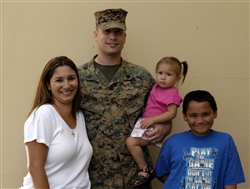
The
Sava family, Staff Sgt. Danny Sava, his wife,
Julia, son, Anthony, and daughter, Alyssa, are
preparing for Danny’s upcoming deployment with
the 15th Marine Expeditionary Unit, with help from
Camp Pendleton’s extensive family support
network. Photo by Cherie Thurlby
|
|
|
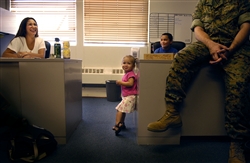
Marine
Staff Sgt. Danny Sava, his wife Julia, son,
Anthony, and daughter, Alyssa, stop by the 15th
Marine Expeditionary Unit command headquarters to
wrap up last-minute details as they prepare for
the unit’s upcoming deployment. Photo by Cherie
Thurlby
|
|
|
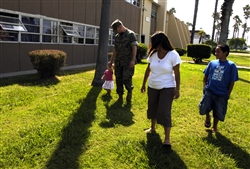
Marine
Staff Sgt. Danny Sava, his wife, Julia, son,
Anthony, and daughter, Alyssa, take a stroll
outside the 15th Marine Expeditionary Unit command
headquarters as they wrap up last-minute details
to prepare for the unit’s upcoming deployment.
Photo by Cherie Thurlby
|
|
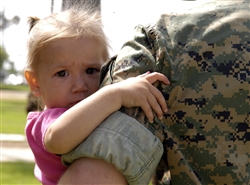
|
Ten-month-old
Alyssa Sava rides on the hip of her father, Marine
Staff Sgt. Danny Sava, unaware that her father
will soon be leaving for a six-month deployment.
Photo by Cherie Thurlby
|
|
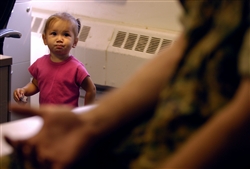
|
Ten-month-old
Alyssa Sava was born the last time her father,
Marine Staff Sgt. Danny Sava, deployed with the
15th Marine Expeditionary Unit. This time, her
father will be away as she celebrates her second
birthday, leaving her in the care of her mother,
Julia, and an extensive family support network to
help them at Camp Pendleton, Calif. Photo by
Cherie Thurlby
|
|
Related Site:
National
Military Family Association
Related Articles:
Operation
Purple Camps Meet Critical Military Family Need
Operation
Purple Sends Deployed Members' Children to Camp
(From a National Military Family Association news release.)
Emergency Registry Helps
Locate Family Members, Friends
By Gerry J. Gilmore
American Forces Press Service
WASHINGTON, Feb. 2005 – As news coverage of the Sept. 11,
2001, terrorist attacks flashed across television and computer
screens, thousands of Americans wondered if family members
living in or visiting New York or Washington, D.C., were alive
and well.
Partially due to the personal turmoil caused by
the 9/11 attacks, Mark Cerney, a disabled U.S. Marine veteran,
established the National Next-of-Kin Registry, a free emergency
contact system that can help citizens find missing loved ones in
the event of serious accidents or catastrophic national
emergencies.
The privately funded NOKR was officially
established in January 2004, Cerney said during a Feb. 24
telephone interview from his office in Temecula, Calif. Four
million people, he said, have registered to date. People can
input personal data about themselves or loved ones at the
registry's Web site.
Registry users, Cerney explained, include
families and individuals registering personal information about
themselves, their children, other relatives, and friends.
"All we need is a name and address as far
as a point of contact (is concerned)," he pointed out,
noting registrants may provide additional information if they so
desire.
Cerney said he first became interested in
starting a next-of-kin registry in 1990, when a family member
died at a convalescent facility in San Diego.
"To my dismay, there was no way to contact
me," noted Cerney, who was in Hawaii at the time,
"even though the people at the facility knew that I was the
next – of kin."
He recalled that he'd lost cell-phone contact
with a close friend who was in New York City on the day of the
terrorist attacks. The friend survived, but Cerney said he was
shaken by the experience.
Cerney cited U.S. Centers for Disease Control
statistics from 2003 that said 900,000 people in hospital
emergency rooms that year couldn't provide emergency contact
information because they were incapacitated by illness or
injury. Several states, he noted, recently have passed laws
requiring hospitals to collect information on patients' next of
kin.
State-issued driver's licenses, Cerney pointed
out, may contain some personal information, but "don't list
a next of kin" in the event of an accident that may occur
far away from the victim's home. And, most Social Security
records, he added, don't identify next of kin.
And, for people who are single and live alone,
Cerney observed, it's much harder for authorities to make a
next-of-kin determination.
Other personal identification organizations
exist, Cerney acknowledged, but they charge as much as $200 for
their services. The NOKR gives affluent, less- wealthy, and
indigent citizens the opportunity to archive personal
information "in the event that that information is
needed," he said.
The NOKR is unique, Cerney said, noting,
"There's been no resource like this anywhere in the United
States."
Some organizations linked to the NOKR, Cerney
noted, include the "FirstGov" federal government Web
site, the International Committee of the Red Cross, the National
Center for Missing Adults, the National Association of Medical
Examiners, the Amber Alert missing children system, homeless
care organizations, and several state and local government and
police agencies and coroner's offices.
The registry also is linked to the Canadian
Resource Centre for Victims of Crime, he said, as well as
several tsunami-victim locator groups.
People who'd hesitate to use the NOKR because of
privacy concerns shouldn't worry, Cerney said. Minimum
information required for registration can be found in phone
books, he explained, and much greater amounts of personal
information can now be readily purchased over the Internet.
You don't
have to be a star to have an agent
FORT LEE, Va. - Having both parents deployed can
be very troubling for children left behind with a caregiver, but
thanks to not-widely known commissary directives their children
can continue to enter the friendly confines of any commissary as
long as they are accompanied by an adult. The military does not
require children under 10 years old to have an identification
card; however, directives permit an approved agent to accompany
children separated from their military parents and act on their
behalf.
"This is not a new policy. It's one that has been on the
books for years," said Robert Vitikacs, the Defense
Commissary Agency's executive director for operations and
product support. Known as the agent privilege, it's for any
authorized commissary shopper who
needs assistance shopping or who cannot shop on his or her own
behalf because of disability, illness or infirmity. That
privilege also extends to grandparents, guardians or caregivers
of children of service members who may not be available due to
deployment or remote assignment. "DeCA does not grant this
privilege," said Vitikacs. "Agent privilege is
authorized by the installation commander who controls who enters
the installation."
The agent does not have to be an authorized commissary shopper.
The military member may request an agent pass for approval to
allow the individual who is the primary caregiver for the
children of deployed parents to enter the installation.
Non-military primary caregivers should contact the
identification card section on the installation to determine
what legal documents, i.e., power of attorney, may also be
needed to establish proof of caregiver status. At the same time,
the individual can also ask what documents are required to enter
the installation. Upon verification of caregiver status, the
individual receives written authorization from the commander's
representative designating him/her as an "agent" to
accompany the children. Usually, the letter is for a 12-month
period, but it can be extended in cases of continued hardship.
"We want to provide a touch of home for children whose
parents are deployed and often, family finances are stretched to
the limit. Whether they're buying for a toddler or a teen, we
can help the agents get the best value for their money by saving
them 30 percent or more on their groceries and personal care
items. It's just one less worry deployed parents will
have,"
Vitikacs added. "I also urge authorized shoppers who are
elderly or disabled, and unfamiliar with the 'agent' privilege,
to contact the identification card section on the installation
to determine what proof is needed to have an agent shop in the
commissary on their behalf," Vitikacs concluded. Chief
Master Sgt. Deborah Brian, DeCA's senior enlisted advisor,
added, "The agent privilege is especially helpful for
Reserve and Guard family members and I strongly recommend
military organizations tell their children's caregivers about
it."
Military
Wives Flock to Internet for Help with Mass Deployments
VIRTUAL
REALITY – As tens of thousands and active duty, Guard and
Reserve servicemembers deploy to the
Middle East
, their wives are turning to CinCHouse.com
for help in coping with marital separation, single-parenting
and financial hardship.
“We’ve seen a huge spike in visitor traffic since
November, when the threat of deployments began to loom,”
said Meredith Leyva, founder of CinCHouse.com. “Similarly, our charitable arm, Operation Homefront,
has been flooded with requests for emergency assistance from
families left behind by deployed servicemembers.”
Determining the status of units, family support
meetings and other official information is another key topic,
especially for Guard and Reserve wives. Because most military wives work outside the home and
have young children, and Guard and Reserve wives often live
far from military bases, attending pre-deployment briefs and
family support meetings can be difficult.
“Since most military wives and female servicemembers
are working moms, it’s easiest to come to CinCHouse
because you can get questions answered almost anytime of the
day or night,” said Leyva. “And we make sure that commands and family support
leaders are engaged in these discussions so that wives are
getting the right
answers and not hysteria or rumors.”
Leyva points out that approximately 100,000 wives and
38,000 female servicemembers enter military life each. Statistically speaking, that means a 100 percent
turnover in military wives every six years. Leyva explains that, with such little historical
reference or experience, military wives often feel they are on
their own to deal with problems. CinCHouse.com’s
job is to raise awareness of all the benefits and
organizations, such as the Navy-Marine Corps Relief Society
and Armed Forces YMCA, that are on hand to help during these
difficult times.
Most important, military wives and female
servicemembers are using CinCHouse
to make friends in new places where they’ve relocated.
As times get tougher, the friendships grow closer.
For more information please visit http://www.cinchouse.com
or call Meredith Leyva at (850) 624-8887.
|
|
|
Spouses
Military
Spouse Headquarters
Army
Assistance
Women's
Web Site
Kids
 
Children's
Financial/Allowance Site
Military
Teens on the Move
Teen
Site
Walt
Disney Channel
Childcare
Locator
Youth,
Children, Family, Education Research
Child
Support Central
|
|
|
|
|
|
|
|
|
|
|
© Partnership Marketing Inc.
No Endorsement Implied
|
|