Military Athletes Have Proud Olympic
History
By Samantha L. Quigley
American Force Press Service
WASHINGTON, Aug. 2004 -- As 21 servicemembers report to Athens
to participate in the 2004 Summer Olympic Games, they carry on
a proud tradition.
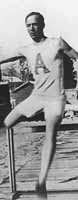
While few records of the Army's participation
in Olympic games exist from before 1948, there is a record of
a 2nd Lt. George S. Patton participating in the modern
pentathlon in the 1912 games. He placed fifth.
Since 1948, more than 400 servicemembers have
participated in summer and winter Olympic games. The Army can
claim 102 total medals for its efforts.
Since the Air Force's inception in 1947, that
service's athletes have won 24 Olympic medals, according to
Steve Brown, chief of Air Force Sports. The Navy boasts at
least 30 medals in the Games from 1948. Marines have
participated in at least 15 Olympics and have won 14 medals
since 1948.
The earliest records place the first Olympic
games at Olympia, in Western Pelloponnese, in 776 B.C. It is
believed, however, Olympic games had been held for several
centuries before that.
Consisting mostly of foot races, the games
gradually grew in scope. First, wrestling and the pentathlon
were added. Today about 312 total events -- 165 for men, 135
for women and 12 mixed events -- are featured in the Summer
Games.
In ancient Greece, the games were understood
as a time of truce between sometimes not-so-cordial cities,
and all Greeks were allowed to participate. For the most part,
this agreement was honored and is a tradition observed in
modern times.
While other games took place in other cities,
it was the Olympic festival in honor of the Olympian Zeus that
gained considerable importance. One of the most popular Pan
Hellenic festivals of the 5th century, the games eventually
became a symbol of political and cultural unity among the
Greeks.
The Olympic Festival, held every four years --
and always during the hottest days of the summer -- included
sacrifices to the gods and, of course, athletic contests. By
the early 1st century, victors were being crowned with wreaths
of wild olive in several events, including wrestling, boxing,
equestrian and the obligatory track-and-field events.
All continued smoothly until the year 394,
when Roman Emperor Theodosius I abolished the time-honored
tradition as part of reforms against pagan practices. While
attempts were made to revive the Olympic games, none were
successful until 1894, when the International Olympic
Committee was founded.
At the urging of French Baron Pierre de
Coubertin, the committee was formed and an oath developed. The
IOC decided the games would be held at periodic intervals, as
had the originals. Also, the games would include
representatives of all countries and all sports.
"To do this was to revive the Olympic
games. The name imposed itself; it was not even possible to
find another," Coubertin said.
Thus the groundwork was laid for the first
International Olympic Games to be held in Athens in 1896.
Fourteen countries sent about 245 representatives to compete
in 43 events. The first modern Olympics were not open to
women, however, as Coubertin decided their participation would
be "impractical, uninteresting, unaesthetic, and
incorrect." Women first competed in swimming events in
the 1912 games.
In 1924, "International Winter Sports
Week" was held in Chamonix, France. Two years later it
was retroactively named the first Winter Olympics.
Time, politics and world events have altered
the face of Olympic competition. The spirit of the
competition, however, remains unchanged. Twenty-one service
members and countless Americans will participate in events or
coach "for the glory of the sport and the honor of our
teams."
(Information obtained from:
www.infoplease.com, www4.army.mil/Olympics/history,
www.fhw.gr/olympics/ancient/index.html, and Achieving
Excellence: The Story of American Military Athletes in the
Olympic Games, 1992.)
Related Articles:
Military
Supports Olympic Hopefuls on the Road to Athens
Airman
earns spot on Olympic track, field team
Military
Athletes Have Proud Olympic History