Military
Supports Olympic Hopefuls on the Road to Athens
By Samantha L. Quigley
American Forces Press Service
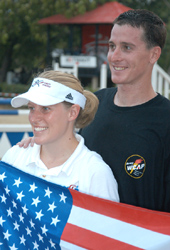 WASHINGTON, July 2004 – Many athletes dream of standing atop
an
WASHINGTON, July 2004 – Many athletes dream of standing atop
an
Olympic medal podium. However, without the necessary
support, even the slightest chance of that happening is a long
shot.
Military athletes can find that support within
their respective services. Though none of the services'
programs are the same, there are similarities.
The Army and Air Force each have two sports
programs available to serious athletes.
The Army's All-Army (Sports Program) chooses a
number of athletes for any of about 20 sports and sends them
to a three-week trial camp, said Karen White, chief of the
Army Sports, Fitness and World Class Athlete Program. If they
make the cut there, they become a member of the All-Army team
for their given sport.
The All-Army team then competes in the Armed
Forces championships. Performance at this level decides
placement on the All-Service team, which competes
international military championships organized by the Conseil
International du Sport Militaire, or better known as CISM.
According to Air Force sports chief Steve
Brown, the Air Force Sports Program is nearly identical.
Athletes are selected from a pool of applications to attend a
training camp and, upon selection, join an All-Air Force team.
With skill and luck, it's on to the All-Service team and CISM
competitions.
Both services also run a World Class Athlete
Program designed to help nationally ranked athletes train
toward a goal of competing in the Olympics. Duration and
location are the two biggest differences between the services'
programs.
The Army allows for a training period of three
years prior to the Olympics. Air Force athletes are limited to
two years. As for location, the Army WCAP is located at Fort
Carson, Colo., near the Olympic training site, while the Air
Force lets athletes train where it's best for them.
The Navy and the Marine Corps' support
structures for athletes are quite different from those of the
Army and Air Force. Neither has a WCAP, nor do they actively
recruit athletes.
For the Navy, once an athlete is identified as
being of Olympic caliber, he or she must request a special
assignment consideration, John Hickok, head of Navy sports,
said. Upon approval of special assignment, the program tries
to relocate the athlete to a location beneficial for training
purposes. Training usually begins about 18 months before the
Games.
If a Marine Corps athlete is invited by a
sport's national governing body to participate at a training
center, he or she then becomes a member of the corps' National
Caliber Athlete Program, Steve Dinote, director of Marine
Corps sports, said.
A Marine athlete is not allowed to train for
more than three and a half years without returning to the
fleet, Dinote said.
Training expenses are always a concern for an
athlete. And all four services offer some type of financial
assistance to their athletes. That assistance is usually in
the form of entry fees, transportation and lodging associated
with competition to advance their goals.
"If you're saying you're going to support
(athletes), then you have to support them with the minimum to
make the team," White said.
If a sport's national governing body taps an
athlete for training, that concern over training costs becomes
less urgent.
Each service has at least one athlete
qualified to participate in the 2004 Summer Olympic Games in
Athens, which begin Aug 13.
Related Articles:
Military
Supports Olympic Hopefuls on the Road to Athens
Airman
earns spot on Olympic track, field team
Military
Athletes Have Proud Olympic History
Three-Time
Olympian's Shooting Gets Better With Age
Captain
to Row for Team USA in Athens Games
Two Soldiers selected for
U.S. Olympic pentathlon team
Date Posted: 6/18/2004
Story: By Tim Hipps
USACFSC Public Affairs
ALEXANDRIA, Va. – Two
modern pentathletes from the U.S. Army World Class Athlete Program have been
selected to compete in the Olympic Games at Athens, Greece.
First Lt. Chad Senior and Capt.
Anita Allen are scheduled to compete Aug. 26 and 27
respectively for Team USA in the one-day, five-sport event
that includes pistol shooting, fencing, swimming, equestrian
riding and cross-country running.
Sgt. Nunn earns Olympic
berth in race walking
Date Posted: 7/26/2004
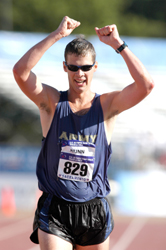
SACRAMENTO, Calif. – Sgt. John Nunn
earned an Olympic berth July 17 with a second-place finish in
the 20-kilometer race walk in the 2004
U.S. Olympic Track and Field Team Trials at Sacramento State University.
Armed Forces land two
athletes on Olympic track and field team
Date Posted: 7/26/2004
Story: By Tim Hipps
USACFSC Public Affairs
SACRAMENTO, CALIF. – Earning Olympic berths, Air
Force 1st Lt. James Parker and Oregon National Guard Capt. Dan
Browne highlighted performances by military athletes during
the first four days of the 2004 U.S. Olympic Track & Field
Team Trials at Sacramento State University.
Parker, who is stationed at Malmstrom Air Force Base in
Montana, won the hammer throw Monday with a hurl of 77.58
meters/258 feet.
“I came here as the favorite and I just wanted to back it up
so I could go to Athens,” he said of making Team USA for the
Summer Olympics in Greece.
Browne, a 1997 graduate of West Point and former member of the
U.S. Army World Class Athlete Program, finished third in the
10,000 meters in 28 minutes, 7.47 seconds on opening night.
Meb Keflezighi of Mammoth Lakes, Calif. won the race in
27:36.49.
Browne, who earlier this year qualified for the Olympic
marathon, said he hasn’t decided yet if he will compete in
both events in Athens.
“I’m going to run the marathon, that’s for sure, but the
10K is a great precursor,” he said. “I need to sit down
with [Coach] Alberto [Salazar] and talk it over.”
Army Capt. Ryan Kirkpatrick, a WCAP distance runner, also
competed in the 10,000 meters but dropped out around the
midway mark to conserve energy for the 5,000 meters Monday
night.
“I was really feeling fatigued at about 3,000 meters into
the race,” he said. “Then the pace really sped up and I
felt the effort was way too much.”
Three nights later, Kirkpatrick was running on the leaders’
shoulders until the final three laps when he faded to a
last-place finish in 14:08.82 in the second semifinal heat of
the 5,000.
Army Sgt. Sandu Rebenciuc finished the second heat of the
3,000-meter steeplechase semifinals Monday in fourth place
with a personal-best time of 8:30:45 that propelled him into
Thursday night’s final.
“It was a [personal record] by only two seconds, but it was
a different kind of PR,” Rebenciuc said. “I came in strong
at the end, looking back, not even pressing that hard. I never
really kicked.”
A native of Romania, Rebenciuc defected in 1988 and came to
the United States in 1990. He joined the U.S. Army in 1998 and
entered WCAP one year later. He competed in the 2000 U.S.
Olympic Team Trials but failed to reach the final. His chance
to make the Olympic team comes Thursday night.
“There are a few guys in there who are really, really tough
to beat, but they could have a bad day and then it’s
anybody’s run,” Rebenciuc said.
Army Spcs. Regan Nichols and Quinton Milner reached the
400-meter semifinals but did not advance to the final. Milner
finished seventh in the first heat in 51.28 seconds. Nichols
was fifth in the second heat in 49.60.
Army Spc. Lakeisha Backus advanced from the first round of the
women’s 100 meters but was eliminated in the semifinals with
a time of 11.52 seconds.
Army Spc. Pamela Simpson finished 12th in the first flight of
the women’s long jump qualifying round with a leap of 6.05
meters/19 feet, 7 inches and failed to reach the final.
Army Capt. Michael Mai, a 2000 graduate of the U.S. Military
Academy at West Point, N.Y., and member of WCAP, fouled on two
of his first three attempts in the hammer throw but launched
the other 68.41 meters to grab the final of eight spots in the
second round of the hammer finals. He finished eighth with a
throw of 68.86 meters/225 feet, 11 inches.
Army Staff Sgt. Tonyo Sylvester finished eighth in the shot
put with a heave of 19.57 meters/64 feet, 2 ½ inches. U.S
Olympic Trials record-holder Adam Nelson won the event at
21.64 meters/71 feet.
Air Force Maj. Richard Harrison did not advance to the finals
of the shot put.
Contact Person: Tim.Hipps@cfsc.army.mil