The
all-new Volvo XC70 – ongoing capable success in a refined
package
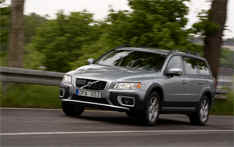
•
Ongoing “crossover” success
•
More luxury and added capability
•
Target 40,000 cars per year
•
U.S. the largest market
•
Sales start in August 2007
When
the first XC model from Volvo Cars took to the roads in 1996,
it was not only an immediate sales success; it also carved out
an entirely new Cross Country segment.
Now
the third generation of the Volvo XC70 steps into the
spotlight at the Geneva Motor Show. With its original recipe
intact – but now with added luxury and in an even more
capable package than ever.
At
its debut just over ten years ago, Volvo Cars expected XC
sales of 15,000 cars. That became 17,500 when American buyers,
above all, discovered that they could have everything that an
SUV could do, but in a true premium car with a distinct Volvo
feel. The term “crossover” was born.
The
Volvo XC70 has retained its power of attraction ever since and
the current generation reached sales of around 40,000 in its
best year.
“We
had a winning concept from the very outset and we have refined
it continuously. The all-new XC70 maintains its tough, capable
attitude while at the same time growing more comfortable. What
is more, our design team has given the car a more elegant,
more luxurious look,” says Volvo Cars President and CEO
Fredrik Arp.

Perfect
for an active lifestyle
The
all-new Volvo XC70 is equally at home outside that favourite
downtown bistro or the opera house as it is on rough forest
tracks, out in the wilderness or halfway up a mountain.
With
an elevated feel in the comfortable, luxurious interior, the
estate car’s functional versatility and the XC model’s All
Wheel Drive and capacity, the all-new XC70 is the perfect tool
for thrilling activities.
Many
lifestyle cars are largely about perception and image.
However, a large proportion of today’s and tomorrow’s XC70
owners choose their car because they intend to fully exploit
its capabilities.
“The
XC70 has primarily been created to get you to the end of the
road. But it has also shown its ability to take you further if
you want to and dare to. A couple of years ago, we organised a
test-drive in Mexico on Baja California’s worst roads, as
close to off-road as you could get. Even the most hardened
adventurers were impressed by what the XC70 could handle,”
recalls Fredrik Arp.
The
all-new XC70 flexes its muscles still further. The model is
available with a six-cylinder petrol or five-cylinder
turbodiesel engine. In the new model, the electronically
controlled all wheel drive from Haldex of Sweden can be
supplemented with the Four-C active chassis with three driving
settings. Features such as Hill Descent Control and ventilated
seats also contribute to a comfortable driving experience.
An
American love affair
The
XC70 will continue to be mainly a North American love affair.
Almost half of the total annual volume of about 40,000 cars
will be shipped over to North America, where the USA is
naturally the largest single market.
However,
the crossover model is also on the upswing in Europe, which
will account for about 40 percent of total sales. Here it is
Sweden that is the largest single market, followed by the
United Kingdom and Germany.
The
all-new XC70 will be unveiled together with the all-new V70 at
the Geneva Motor Show in early March. Sales will get under way
at the end of August, starting in Scandinavia. Other markets
will follow gradually during the rest of 2007.
Introduced
in China too
Volvo
is also planning to introduce the all-new XC70 in China, which
is quickly expected to reach third place in the model’s
sales statistics.
“There
is a considerable appetite for cars with pronounced attitude
on the fast-growing Chinese market. The Volvo XC90 is already
very popular and we are convinced the all-new XC70 will play a
significant role in our plans for continued fast sales growth
in China,” says Fredrik Arp, and adds:
“Our
successful XC range will soon be expanded with the new XC60.
With three exciting XC models, we will cover even more of the
growing number of car buyers who want the very best of two
worlds – capable muscles and luxurious, comfortable
passenger-car comfort. And it all began with the XC70, which
has now become even more attractive than before.”
Descriptions
and facts in this press material relate to Volvo Cars’
international car range. Described features might be optional.
Vehicle
specifications may vary from one country to another and may be
altered without prior notification.
All-new
XC70 generation with sportier
attitude and greater capability
1.
Improved child safety with a world innovation
2.
Advanced drive systems contribute to increased safety margins
3.
Six-cylinder engine for the first time in the Volvo XC70
4.
All Wheel Drive and advanced drive systems
5.
First-class comfort and versatile function
6.
World class audio system
The
all-new Volvo XC70 is the third generation of Volvo’s
capable cross-country model.
Just
like the all-new V70 model, it offers everything that implies
of luxury and a spacious interior, sporty driving properties
and high comfort. In addition, the all-new Volvo XC70 has a
number of smart solutions for increased flexibility and
practical function.
Safety
is naturally at the highest level and the car also includes
Volvo’s world breakthrough: integrated child booster
cushions with a choice of two seating heights.
“The
all-new Volvo XC70 has been developed for people who want to
live out their dreams,” says Lex Kerssemakers, Senior Vice
President Brand, Business and Product Strategy at Volvo Cars.
“It has the right attitude, capacity and equipment for
enjoyable trips to and from your adventures. And just like the
all-new V70 model, it clearly marks Volvo’s increasingly
strong position in the premium segment. It is therefore
logical that the all-new Volvo XC70 should inherit much of the
same character and properties. We recognize the design, the
comfort and the high safety level. The fact that the all-new
Volvo XC70 is now even more versatile and capable than its
predecessor is a direct response to our customers’ expressed
wishes and needs.”
1.
Improved child safety with a world innovation
•
Improved child safety with extended IC (Inflatable Curtain)
and integrated booster cushions – a world breakthrough
•
New, stronger side structure
•
Crumple zones made from different grades of steel
•
Lower cross-member contributes to enhanced compatibility
•
Compact transverse engines contribute to collision safety
•
Second-generation WHIPS system
•
Protection for other road users
•
Other protective safety solutions
“When
we developed the all-new Volvo XC70 the goal, as for the
all-new Volvo V70, was that it should be the safest car in its
segment,” says Ingrid Skogsmo, Director Volvo Cars Safety
Centre. “The XC70 model shares the same sophisticated
network of interacting safety systems as the Volvo S80.The
patented body structure absorbs energy in a highly efficient
way. And the interior safety system includes the latest
generation of side airbags and whiplash protection. What is
more, we are introducing a world innovation in the field of
child safety.”
Improved
child safety with extended IC (Inflatable Curtain) and
integrated booster cushions – a world breakthrough
To
improve safety for children in the rear seat of the all-new
XC70 model, Volvo has further developed the Side Impact
Protection System (SIPS) with a stronger body structure,
extended inflatable curtains and a height-adjustable
integrated child booster cushion – the latter a world
innovation.
The
booster cushion, which is integrated in the rear seat, can be
set at two heights, allowing children of different sizes to
sit sufficiently high to see out through the windows yet at
the same time get the most effective protection possible. The
lower setting is intended for children between 115 and 140 cm
in height and weighing between 22 and 36 kg, while the upper
setting is designed for children measuring 95-120 cm and
weighing between 15 and 25 kg. The all-new Volvo XC70 can be
equipped with integrated child booster cushions in both outer
rear seats.
The
adjustable booster cushion means the seat belt geometry is
optimum irrespective of the child’s height. The integrated
booster cushion is also accompanied by safety belts with
specially adjusted force limiters. They contribute to the best
possible protective effect by restraining the child with just
the right amount of tensioning force in a collision.
The
inflatable curtains in the all-new Volvo XC70 have been
extended by 60 mm, which in combination with the
height-adjustable booster cushions and the strong body side
structure provide more children of different sizes with
effective protection in a side impact.
Furthermore,
the fact that more children are provided with comfortable
seating on booster cushions helps create a more harmonious
atmosphere in the car and provides better conditions for
relaxed driving.
The
front passenger airbag can be disabled using a key. What is
more, the seat can be specified with attachments for
rear-facing fitting of a child seat once the front passenger
airbag is disabled.
New,
stronger side structure
To
optimise side-impact protection in the all-new XC70 model, not
only for children but for all occupants, the body’s entire
side structure is both stronger and lighter thanks to a
well-balanced combination of high-tensile steel of different
grades (High Strength Steel, Extra High Strength Steel and the
extremely strong Ultra High Strength Steel). The various
components and grades of steel interact to minimise
penetration into the passenger compartment. The aim is instead
to get the entire car to move sideways – away from the
colliding vehicle.
The
new type of side-impact airbag which was launched together
with the all-new S80 model makes Volvo’s patented SIPS (Side
Impact Protection System) into an even more effective safety
system. The new side impact airbags have two separate chambers
– one for the hip section and one for the chest. Since the
hips can withstand greater force than the chest can, the lower
chamber inflates with up to five times more pressure than the
upper section. The side-impact airbags interact with the
inflatable curtains and the body’s network of safety beams
to provide the most effective protection.
Crumple
zones made using different grades of steel
The
patented front body structure in the all-new Volvo XC70 is
divided into zones, each of which has a different task during
the deformation sequence. The outer zones are responsible for
most of the deformation. The closer the collision forces get
to the passenger compartment, the less the material deforms.
In
order to give each zone the right properties, different grades
of steel are used in different structures, a total of four
different grades. Apart from regular body steel, three
different grades of high-tensile steel are used: High Strength
Steel, Extra High Strength Steel and Ultra High Strength
Steel.
“With
the zone system, we can exploit the material’s properties to
the very maximum for the best possible energy absorption,”
explains Ingrid Skogsmo. “The aim is that the passenger
compartment should be preserved in a predictable way in a
variety of collision scenarios.”
ZONE
FOR DEFORMATION AT LOW SPEEDS
The
front bumper is structured around a cross-member made of
aluminium. The attachment points at the body’s longitudinal
beams are designed as collapsible “crash boxes”. They help
absorb incoming low-speed collision forces without damaging
the rest of the body’s beam structure.
ZONE
FOR DEFORMATION AT HIGH SPEEDS
The
straight sections of the longitudinal beams are made of High
Strength Steel, a very tough grade of steel that is optimised
for high energy absorption. This zone accounts for most of the
deformation.
ZONE
FOR BACKUP
The
beam section that curves out towards the A-posts serves as a
barrier protecting the passenger compartment and also as a
backup to reduce deformation. Its shape also helps minimise
the risk of the front wheel penetrating into the passenger
compartment. Instead, the wheel helps absorb the collision
forces. This section is very rigid and is made of Extra High
Strength Steel.
THREE-POINT
ATTACHMENT
A
rigid cross-member links the two A-posts and the lower
side-members so that they form a particularly sturdy
three-point attachment on each side. This design is
particularly effective at protecting the passenger compartment
in a severe impact.
Lower
cross-member contributes to enhanced compatibility
With
its high ground clearance, the all-new Volvo XC70 comes with
relatively high-positioned bumpers, which may create a greater
risk of damage to an oncoming passenger car with lower
positioned bumpers. To reduce the risk of injury in a
collision, the front suspension subframe in the Volvo XC70 is
supplemented with a lower cross-member, positioned at the
height of the bumper in a conventional car. This lower beam is
integrated into the XC70’s structure and is neatly concealed
behind the spoiler. In a collision the lower cross-member is
aimed to strike the oncoming car’s protective structure,
activating its crumple zone as intended so the occupants can
be given the maximum level of protection.
Compact
transverse engines contribute to collision safety
Like
its larger stablemate in the XC range, the Volvo XC90, the
all-new Volvo XC70 has a transverse driveline and four-wheel
drive. Transverse installation gives the engine more space
inside the engine compartment and helps reduce the risk of
penetration into the passenger compartment in a frontal
impact.
Even
the six-cylinder engine has been able to be installed
transversely in the all-new XC70 model thanks to its extremely
compact format and efficient packaging in the engine
compartment.
Second-generation
WHIPS system
Volvo’s
system for avoiding neck injuries – WHIPS (Whiplash
Protection System) – is one of the most effective on the
market. In the event of a rear-end collision the front seat
backrest accompanies the passenger’s initial body movement
and dampens the incoming force rather like one’s hand does
when catching a ball.
The
all-new Volvo XC70 features the same generation of WHIPS
mechanism as was launched on the all-new S80 model. This
generation was further developed to ensure that the damping
motion is gentle and to provide good contact between the head
and head restraint throughout the impact sequence.
Protection
for other road users
Protection
for pedestrians and cyclists has also been further developed
in the all-new Volvo XC70. The front has been given
energy-absorbing properties, not least with a generously
dimensioned soft structure in front of the bumper that helps
reduce the risk of leg injuries. In addition, the spoiler’s
lower edge has been reinforced and moved forward, almost on a
level with the bumper. The aim is that the area of contact on
a pedestrian’s or cyclist’s leg should be distributed
across a larger area, thus helping reduce the risk of injury
still further.
The
bonnet is raised and its underside has a honeycomb structure
which similarly spreads the load in the event of an impact,
thus helping to absorb the energy and reduce the risk of
personal injury.
Other
protective safety solutions
•
Collapsing steering column which upon deformation moves
horizontally for the best possible interaction with the airbag
•
Pedals with a function that limits the risk of penetration
into the passenger compartment
•
Airbags with two-stage function
•
Seat belt pre-tensioners for all five seats
•
Seat belt reminders for all five seats
•
Force limiters for the front seat belts
•
Reinforced, transversely fitted tubular beam between the
A-posts
•
Strong SIPS tubes in the seats and a sturdy magnesium bracket
in the middle of the car
•
Diagonally fitted beams of Ultra High Strength Steel in the
doors
2.
Advanced drive systems contribute to increased safety
margins
•
Collision warning with brake support and emergency brake
lights
•
Adaptive cruise control
•
Advanced information systems contribute to better driver
control
•
Active Bi-Xenon Lights – swivelling headlamp beams
•
Advanced, interacting braking functions
•
Personal Car Communicator with heartbeat sensor provides
enhanced security
•
Laminated glass all round and automatically locked storage
unit in the luggage compartment
“The
best way to protect the car’s occupants is to avoid
accidents,” says Ingrid Skogsmo. “That’s why we’ve
developed a number of advanced driving and support systems
that interact intelligently to assist the driver in difficult
situations, yet without taking over the driving itself or
taking over responsibility for safe progress. The task is to
assist the driver to take the right decisions, by alerting him
or her and in various ways indicating how best to get out of
the situation.”
Collision
warning with brake support and emergency brake lights
Rear-end
collisions are a common type of accident. In many of these
cases, the reason is that the driver is distracted and fails
to respond in time.
Against
this background, Volvo Cars has developed a system known as
Collision Warning with Brake Support. It is an advanced system
with auxiliary functions that aim to avoid rear-end impacts or
to minimise their consequences should they nevertheless occur.
The
area in front of the car is continuously monitored with the
help of a radar sensor. The system is activated in a variety
of ways at different stages of the sequence:
If
the car approaches another vehicle from the rear and the
driver does not react, a red warning lamp flashes in the
windscreen. At the same time, a warning buzzer sounds. In
certain situations this is enough for the driver to respond
and take action to avoid the danger.
If
the risk of a collision increases despite the warning, the
brake support system is activated. In order to shorten the
reaction time, the brakes are prepared for action by automatic
application of the pads against the discs. In addition, brake
pressure is amplified hydraulically, which results in good
braking effect even if the driver does not press particularly
hard on the brake pedal.
“If
the road speed is not too high, brake support helps reduce the
consequences of a collision,” says Ingrid Skogsmo.
“However, it is always the driver’s reactions that are
crucial to the outcome.”
The
application of firm braking is signalled to traffic behind the
car by the brake lights first flashing (valid for Europe –
fixed light for US markets). Once speed drops to below 30
km/h, the hazard warning flashers are also activated.
In
order to adapt the warning system to different conditions and
individual driving styles, the system’s sensitivity can be
adjusted in the car’s setup menu. There is a choice of three
settings.
Adaptive
cruise control
In
order to help the driver stay a safe distance behind the
vehicle in front, Volvo Cars has developed Adaptive Cruise
Control (ACC). This system should primarily be regarded as a
comfort function but it does also contribute to more
controlled progress if the rhythm of traffic is uneven. The
technology is also used as a basis for several of Volvo’s
advanced driving and support systems.
Using
a radar sensor, the adaptive cruise control continually
monitors the gap to the vehicles in front and automatically
adjusts the car’s speed to ensure that this gap does not
shrink too much.
The
driver activates the cruise control by setting a desired speed
between 30 and 200 km/h and then selecting the minimum time
gap to the vehicles in front. There are five different time
gaps to choose between.
Advanced
information systems contribute to better driver control
The
all-new Volvo XC70 is also equipped with BLIS (Blind Spot
Information System) and IDIS (Intelligent Driver Information
System), two systems that can help the driver maintain better
control over the driving situation.
Using
cameras integrated into the door mirrors, BLIS registers
whether another vehicle is in the blind spot offset to the
rear of the car. If there is a vehicle there, a lamp lights up
at the relevant mirror to alert the driver and increase his or
her chance of making the appropriate decision.
IDIS
is an electronic information system that helps prevent the
driver from becoming distracted by irrelevant information in
busy situations. By continuously monitoring certain functions
in the car such as steering wheel movements, the movement of
the accelerator pedal, turn indicator usage and brake
application, IDIS can assess the complexity of the current
situation. The information is processed and at a certain level
of complexity, any information that is not essential to safety
is delayed, for instance incoming phone calls or SMS text
messages.
Active
Bi-Xenon Lights – swiveling headlamp beams
In
order to contribute to the best possible visibility during
night-time driving on curving and twisting roads, the all-new
Volvo XC70 can be equipped with Active Bi-Xenon Lights – swiveling
headlamps that follow the sweeps and bends of the road. A
mini-processor is used to calculate and analyze a number of
parameters and optimize the light beam to suit the situation.
The headlamps can be swiveled up to 15 degrees in either
direction, totaling 30 degrees, and can thus light up a longer
stretch of road as it twists and turns. In order to save wear
and tear on the system, it is automatically deactivated in
daylight conditions.
In
order to lower the risk of dazzling oncoming traffic, the
headlamps’ height is adjusted depending on how heavily the
car is loaded and also on whether the car is accelerating or
braking.
The
headlamps are cleaned using an electromagnetic high-pressure
system that washes one headlamp at a time so as to always
provide the best possible illumination under all conditions.
Advanced,
interacting braking functions
The
all-new Volvo XC70 has a highly advanced braking system with a
number of functions that interact to ensure the shortest
possible braking distance under all circumstances.
HYDRAULIC
BRAKE ASSIST (HBA) is a new generation of Volvo’s emergency
braking support system. It helps the driver to brake in the
shortest possible distance in a panic situation. Unlike the
previous system which was only based on vacuum, here brake
pressure is also reinforced hydraulically. In an emergency
situation where the driver does not press the brake pedal
sufficiently quickly and firmly, HBA can help ensure that the
ABS system is utilised optimally and the braking distance is
reduced.
OPTIMIZED
HYDRAULIC BRAKES (OHB) reinforce braking ability under hard
braking by utilising hydraulics to compensate for low vacuum
pressure in the brake servo.
READY
ALERT BRAKES (RAB) can predict rapid braking and apply the
brake pads against the discs even before the driver has time
to press the brake pedal. The braking system’s response time
– and the braking distance – can thus be shortened. The
triggering signal for the braking system may be that the
accelerator pedal is released suddenly or that the adaptive
cruise control registers an obstacle in front of the car.
FADING
BRAKE SUPPORT (FBS) utilises the hydraulics to gradually build
up braking pressure during long hard braking, thus helping cut
the risk of brake fade and maintaining pedal feel.
Personal
Car Communicator with heartbeat sensor provides enhanced
security
In
an increasingly insecure world, it is important to have
control over what happens in one’s immediate vicinity, not
least when you park your car. This is a matter both of
preventing theft of and from the car and also of avoiding
situations that may involve personal risks.
Together
with the all-new S80 model, Volvo Cars launched the Personal
Car Communicator (PCC), an advanced pocket-sized control center
which is now also available on the all-new Volvo XC70. The
Personal Car Communicator provides information which in some
circumstances may be crucial to the car owner’s security and
safety.
The
Personal Car Communicator is remarkably like a regular remote
control but it can do a lot more than just activate the locks
and alarm. A simple push of a button can within a few seconds
tell the car owner if …
…
the car is locked or unlocked …
…
if the alarm has been triggered …
…
if the alarm has been triggered and someone is inside the car,
which can be registered by a highly sensitive heartbeat sensor
and an advanced calculation process.
The
information is available and up-to-date as long as the
distance between the PCC and the car is about 100 metres or
less. In addition, the most recent data is logged so the owner
can at any time and any place check whether the car really was
locked when it was parked.
Laminated
glass all round and automatically locked storage unit in the
luggage compartment
In
order to make break-ins more difficult, the all-new Volvo XC70
can be specified with laminated glass in all the windows,
including the rear side windows and the tailgate. This means
that the luggage compartment too gets effective protection.
The
rear storage system under the luggage compartment floor has a
capacity of no less than 46 litres if the car does not have a
spare wheel, and it is now lockable. It is locked
automatically and conveniently when the tailgate is closed and
locked.
3.
Six-cylinder engine for the first time in the Volvo XC70
•
Six-cylinder normally aspirated engine with dual cam profiles
•
Extremely compact design
•
Energy-efficient turbo diesel from second-generation D5 range
•
Petrol and diesel engines at the launch of the all-new Volvo
XC70
•
Six-speed Geartronic
“We
can now for the first time ever offer a six-cylinder engine in
the Volvo XC70,” says Tomas Ahlborg, Project Director for
the all-new XC70. “It is the extremely compact transverse
in-line unit made of aluminum that was launched in conjunction
with the all-new Volvo S80. With six cylinders and a
displacement of 3.2 liters, the XC70 gets the power and drivability
that a true adventurer needs. With this new power plant, we
can give discerning customers an entirely new and longed-for
driving experience.”
Six-cylinder
normally aspirated engine with dual cam profiles
The
six-cylinder normally aspirated engine producing 175 kW (238
hp) and 320 Nm offers a high-class driving experience. The
engine has an advanced valve mechanism featuring dual cam
profiles on the inlet side. With CPS (Cam Profile Switching),
as the system is known, the inlet valves can be raised to two
different heights depending on engine revs and load.
In
normal driving, with normal throttle activation and low engine
revs, fuel consumption is minimized at the same time as there
is sufficient torque for good drivability.
In
sportier driving, under full acceleration and high revs, the
engine is immensely alert to the throttle and powerful at both
low and high speeds.
“In
principle two engines in one,” explains Thomas Ahlborg
“satisfying both performance-orientated customers and those
who prioritize driving comfort and fuel economy.”
In
addition, the engine features VIS (Variable Intake System). It
consists of two throttle valves that adjust the volume of the
inlet manifold to suit the current driving conditions and
allow the engine’s capacity to be exploited to the very
maximum throughout the rev range.
Extremely
compact design
As
in the other Volvo models, the engines in the all-new Volvo
XC70 are installed transversely, even the six-cylinder unit.
This has been made possible owing to an extremely compact
construction.
“A
transversely mounted compact engine is the best way to reduce
the risk of penetration into the passenger compartment in the
event of a frontal collision, since the engine takes up
minimal space in the car’s longitudinal direction,”
explains Tomas Ahlborg.
The
six-cylinder in-line engine’s compact format has been
achieved by positioning ancillaries such as the power steering
pump and air conditioning compressor behind the engine in the
space above the gearbox. There is therefore no drive system
for these ancillaries in front of the engine. Instead, drive
is provided via gears on the rear of the crankshaft. This
solution is called READ – Rear End Ancillary Drive. The
alternator is direct-driven and is fitted onto the engine
block. These solutions mean the entire package including the
engine and gearbox take up the least possible space, above all
in the car’s longitudinal direction.
By
designing the drive system in the form of a small
“gearbox” with an intermediary shaft inside the drive shaft
– a solution known as Shaft In Shaft – the whole package
has been able to be made very short. The two shafts are driven
by different gears that give them different speeds (one speed
for camshaft drive and one for powering the ancillaries).
Even
the vibration damper, which compensates for vibrations in the
six-cylinder engine’s relatively long crankshaft, has been
integrated inside the engine block.
Energy-efficient
turbo diesel
As
an alternative to the six-cylinder normally aspirated engine,
the all-new Volvo XC70 can be specified with Volvo’s
in-house manufactured second-generation D5 five-cylinder
diesel engine. It is a very powerful and easy to drive turbo diesel
which is available in two versions. The more powerful variant
offers no less than 400 Nm of torque – and it does so across
a particularly wide rev range.
Compared
with the first generation, the new D5 engine has been further
developed and comprehensively refined, featuring a new
electronically controlled turbocharger, more advanced
multi-point injection technology and a particularly powerful
engine management system. The improvements have resulted in an
entirely new driving experience with far higher performance
and improved drivability. At the same time, emissions are
noticeably lower.
A
service-free particle filter is standard, making the D5 a
highly eco-efficient alternative.
Both
the engines feature four valves per cylinder and double
overhead camshafts, promoting alert response and good
high-speed properties.
Petrol
and diesel engines at the launch of the all-new Volvo XC70
Engine
Configuration
Output kW/hp
Torque Nm
3.2
I6 petrol I6
175/238
320
D5
diesel
I5
136/185
400
Six-speed
Geartronic
The
two engines in the all-new Volvo XC70 are mated to a six-speed
gearbox, manual or automatic with Geartronic. They are
designed to handle the huge power of these engines. With
Geartronic it is also possible to change gear manually.
4.
All Wheel Drive and advanced drive systems
•
Advanced body structure and stable chassis promote controlled
ride and road holding properties
•
Active chassis with Four-C – and three choices
•
All Wheel Drive with Instant Traction
•
Hill Descent Control regulates speed on steep downhill
gradients
•
Adjustable power steering
•
Power Parking Brake is standard
•
DSTC is standard
“The
all-new Volvo XC70 has been further developed in every
respect,” says Tomas Ahlborg. “The chassis technology
offers high-class driving feel and superb control whatever the
situation. With the intelligent All Wheel Drive system and
raised ground clearance, we furthermore add in those
characteristic XC properties of excellent get-you-there
ability and formidable capability. What is more, we are
launching Hill Descent Control, which makes it easier to
master crawling in low gear on steep downhill gradients.”
Advanced
body structure and stable chassis promote controlled ride and road holding
properties
Not
only the driveline but the whole of the car has been developed
and balanced to give a first-class driving experience, based
largely on pliant ride and secure road holding allied to high
stability. Stability is in fact particularly important when
driving with a heavy load and on poor surfaces.
The
body features a highly advanced structure that contributes to
both good deformation properties in the event of a collision
and high torsion rigidity. Thanks to the design of the body
structure and the optimized use of different grades of
high-strength steel, the torsion rigidity has been increased
by no less than 15 percent compared to the previous XC70
model. Good torsion rigidity is the very basis of the car’s
excellent ride and road holding properties.
The
chassis technology has been further developed compared with
the previous XC70 model to provide even more stable and more
controlled road manners. A lot of effort has also gone into
features such as the suspension system and engine installation
to ensure high-class comfort.
In
order to provide the necessary get-you-there ability on
difficult surfaces, the XC70 has raised ground clearance. It
rides 210 millimeters high.
Active
chassis with Four-C – and three choices
The
all-new Volvo XC70 can be optionally specified with an active
chassis based on Volvo’s Four-C technology. It is an
advanced self-regulating chassis system that uses a number of
sensors to continuously monitor the car’s behavior. The
dampers are adjusted to suit the current driving conditions in
mere fractions of a second.
Four-C
adjusts chassis settings to match the car’s speed. The
higher the speed, the firmer the damping. This makes the car
easy to control even at high speeds. This technology also
reduces the car’s tendency to squat, dip or yaw under hard
acceleration, firm braking and quick steering wheel movements.
“With
an active chassis, the car’s driving properties improve in
all situations,” says Tomas Ahlborg. “It becomes both
safer and more entertaining to drive.”
Three
alternative chassis settings at the touch of a button allow
the driver to alter the car’s driving character to suit his
or her personal taste.
•
COMFORT provides pleasant, comfortable progress with calm,
harmonious body movements.
•
SPORT provides more controlled body movements, faster steering
response and a higher degree of road contact.
•
ADVANCED gives minimum damper movement and maximum contact
between tyres and road surface. It’s the setting for
enthusiastic driving on smooth and flat asphalt.
In
a difficult-to-control situation, however, the driver’s
choice makes no difference at all: Four-C always responds by
helping the driver out of the situation by automatically stabilizing
the car to maintain control.
All
Wheel Drive with Instant Traction
The
all-new Volvo XC70 is equipped with Volvo’s All Wheel Drive.
Using an electronically controlled hydraulic clutch, the AWD
system distributes drive between the front and rear wheels to
ensure the best possible road grip in all situations. The
system features Instant Traction, which shifts drive at
lightning speed from the front to the rear wheels when
starting on a slippery or loose surface.
Hill
Descent Control regulates speed on steep downhill gradients
“Some
off-road cars have an extra low gear for crawling, but we have
chosen a more sophisticated solution that better suits our XC
concept,” says Tomas Ahlborg. “It’s called Hill Descent
Control (HDC) and makes it easier to crawl in bottom gear on
steep downhill slopes.”
Using
the car’s brakes and engine torque, HDC controls the car’s
speed and keeps it steady at about 10 km/h. This function is
activated via a button in the instrument panel. The driver can
easily take command over HDC by pressing the accelerator or
brake pedal. Changing gear automatically disengages HDC. All
changes take place smoothly and gently.
Thanks
to the smooth response when the accelerator is pressed, Hill
Descent Control also contributes to comfortable starts when
towing a caravan. On a slippery surface, which is sometimes
the case in camping grounds, this is extra beneficial.
Hill
Descent Control also operates when reversing so it can be of
considerable help at the slipway when launching a boat into
the water. The system operates with both manual and automatic
gearboxes.
Adjustable
power steering
Speed-dependent
power steering is available as an option. The system delivers
more servo assistance at low speeds, for instance to make
things easier when crawling slowly on difficult surfaces.
Servo assistance is reduced as speed rises, disappearing
entirely at higher cruising speeds.
In
order to give every driver the most optimum road feedback,
servo effect can be adjusted via the car’s information and
set-up system. Three levels of servo assistance are available.
Power
Parking Brake is standard
In
order to assist the driver when starting on an uphill
gradient, the all-new Volvo XC70 has a smart, electrically
operated parking brake system known as Power Parking Brake.
This makes things far easier for the driver, especially if the
car is fitted with a manual gearbox. If the parking brake is
engaged at traffic lights, for instance, it is automatically
disengaged when the accelerator is pressed and the car moves
off. Please note that the driver’s safety belt must be
secured for this function to operate.
The
parking brake is engaged by pushing a lever to the left of the
steering wheel and disengaged by pulling the lever.
To
ensure that the parking brake is applied when the car is
parked, it is automatically engaged when the key is removed
from the ignition switch or, if the car is equipped with
Keyless Drive, when the door is opened. This function must be
selected initially in the car settings menu.
DSTC
is standard
DSTC
(Dynamic Stability and Traction Control) is standard in the
all-new Volvo XC70. This is a stability-enhancing system that
when necessary reduces engine torque and applies carefully
calculated braking power to reduce the risk of a skid.
“By
combining systems such as Four-C, AWD and DSTC we can offer a
driving experience of extremely high caliber under virtually
all operating conditions, even when the car is loaded,” says
Tomas Ahlborg. “The fact that the driver can also influence
the car’s character via the alternative chassis settings
makes the experience and the feeling of control even more
highly appreciated.”
5.
First-class comfort and versatile function
•
Increased legroom
•
Ventilated seats
•
Clean Zone Interior Package provides enhanced comfort
•
Personal comfort settings
•
Smart and versatile functionality
•
Versatile load compartment floor makes loading easier
•
Power-operated tailgate
“By
building on the modern S80 base when we designed the all-new
XC70 model, we have been able to improve both comfort and the
scope for utilizing the vehicle in an intelligent way,” says
Tomas Ahlborg. “More interior space and more versatile
functions make the all-new Volvo XC70 a truly capable
companion for adventurers and everyday motorists alike.”
Increased
legroom
The
all-new Volvo XC70 is both more spacious and more comfortable
than its predecessor. The distance from front to rear
passengers has been extended by 21 millimeters, rear legroom
by 48 millimeters and rear knee clearance by 21 millimeters.
Large drivers and passengers will be happy to note that width
at shoulder height has been increased by 30 millimeters in the
front seats.
Ventilated
seats
Volvo’s
front seats are regarded by many as the very best on the
market. They are designed to offer the best possible support
and comfort, even on long trips. Power-adjustable seats are
available as an option, and they can be equipped with
perforated and ventilated leather upholstery. These seats are
equipped with fans in the seat and backrest cushions. The
temperature in the cushions is swiftly lowered to a pleasant
level and contributes to superb seating comfort, especially on
hot days and in humid climates.
The
opposite effect – heating of the front seats when the
weather turns chilly – can be selected at a choice of three
temperature settings. The rear seat too can be specified with
heating, which includes separate switches for each of the two
outer seats and, as in the front seats, three temperature
settings.
Clean
Zone Interior Package provides enhanced comfort
In
order to give particularly sensitive passengers a better
interior in-car climate, the all-new Volvo XC70 can be
equipped with the Clean Zone Interior Package, a system that
is based on ECC (Electronic Climate Control) and IAQS
(Interior Air Quality System).
When
the car is unlocked using the remote control, the passenger
compartment is automatically ventilated for about a minute if
the outdoor temperature is higher than 10 degrees Celsius.
Clean Zone Interior Package creates a passenger environment
that has been approved by the Swedish Asthma and Allergy
Association.
The
interior trim materials and fittings have been selected to
emit minimum levels of harmful substances.
Personal
comfort settings
The
XC70 driver has a wide range of scope for adjusting the
car’s comfort functions to suit his or her personal needs
and wishes. These settings are altered in the car’s
information system. The menu includes the seats, rear-view
mirrors, climate unit, audio unit, navigation system and to a
certain extent the car’s driving properties. One of the
selectable functions is automatic operation of the rear
defroster. When this setting is chosen, the defroster is
automatically activated when outside temperature is about 9
degrees C. Another example is the speed-dependent power
steering. It is an option and can be set at one of three
levels via the information system.
“Being
able to alter settings oneself gives added comfort,” says
Tomas Ahlborg. “However, from the safety viewpoint it is
important that we do not spend too much time on the menu
system while driving. In order to prevent the driver from
losing concentration on the road while driving, certain
functions are therefore blocked in the menu after about 20
seconds.”
Smart
and versatile functionality
“The
all-new Volvo XC70 is synonymous with versatility and enhanced
capability,” says Tomas Ahlborg. “Plenty of space, a
three-part rear seat and a number of intelligent functions
make loading and travel a real pleasure, both with and without
luggage.”
The
rear seat splits 40/20/40, with two very comfortable seats and
a convenient armrest in between. The centre backrest can be
folded to make space for long cargo items or raised to provide
an additional seat. The backrests can be folded separately to
create a larger load compartment with an entirely flat floor.
With the foldable backrest in the front passenger seat, the
combination possibilities are even greater.
The
luggage compartment floor is equipped with aluminum rails and
movable anchorage points to secure the load. The anchorage
points can be tucked down into the rails when they are not in
use so they are entirely out of the way. The side panels also
have built-in load anchorage eyelets to keep luggage securely
in place. What is more, they can be supplemented with
multifunctional rails for a variety of hooks, load-anchoring
nets, cargo space dividers and other load-related accessories.
In
order to protect the luggage compartment floor there is a wide
range of mats, including one that can be folded double for
normal use or opened out across the entire luggage compartment
floor when the rear backrests are folded down.
Versatile
load compartment floor makes loading easier
An
extra sliding load floor is available as an accessory. It is
fastened simply and quickly in the floor rails and slides out
easily over the bumper to permit convenient loading. It is
automatically locked into place when the handle is released.
When it is not in use, the floor can easily be removed from
the car altogether.
The
sliding floor and complete load system fulfill Volvo’s
extremely high demands for safety.
Power-operated
tailgate
Loading
is can be made even more convenient by the fact that choosing
the optional power-operated tailgate is power-operated.
It is opened by pressing a button on the remote control, and
the rest is handled by the car’s hydraulics. Handy when your
own hands are full. In order to reduce the risk of
accidentally squashing one’s hands or fingers, it is closed
from the panel on the tailgate itself. What is more, there is
a dual-stage safety function integrated into the tailgate,
involving a pinch protection moulding on each side and an
emergency stop, which means that the hydraulic system is
equipped with a force sensor, stopping immediately if it
senses an obstruction during operation. A wide range of
accessories featuring holders for such equipment as bikes,
kayaks, skis and snowboards is available for cars with or
without rails. Bikes can also be transported inside the car,
secured to the floor rails using a special holder.
6.
World class audio system
•
Digital technology contributes to natural sound profile
•
Automatic volume and tone adjustment
•
Three performance levels
•
Dolby Pro Logic II Surround with adjustable sound pattern
•
World-famous loudspeakers from Dynaudio of Denmark
•
Optional subwoofer provides richer bass tones
•
Plays MP3 format
•
Integrated DVD system in the rear seat
•
The latest-generation RTI
“Volvo’s
audio systems are among the very best in the automotive world
today,” says Tomas Ahlborg. “And obviously only the best
is good enough in a car of the calibre of the all-new Volvo
XC70. In cooperation with the foremost audio manufacturers in
the world, we have developed a first-class sound system with a
digital amplifier from Alpine, Dolby Pro Logic II Surround and
excellent loudspeakers from Danish experts Dynaudio. The
result is an audio experience of absolute world class.”
Digital
technology contributes to natural sound profile
The
very latest in digital technology has been used to control and
adjust sound reproduction to suit the shape of the passenger
compartment and the positioning of the loudspeakers. Using DSP
– Digital Signal Processing – the tone curve has been
fine-tuned so it contributes to natural audio quality.
Digital
technology is also used in Volvo’s modern amplifier,
developed in cooperation with Alpine. A digital class D
amplifier has extremely low current consumption thanks to its
high efficiency rating. This also means that it produces less
heat than an analogue amplifier and that it can be made more
compact.
Volvo’s
amplifier also has a particularly high damping factor thanks
to ICEPower® technology from Denmark’s Bang & Olufsen
PowerHouse a/s. This technology contributes to crystal-clear
yet powerful sound all the way down to the deepest bass tones.
Automatic
volume and tone adjustment
Owing
to the use of digital technology, the sound can be adjusted to
match the driving situation. Not only volume but tone too is
adjusted automatically in response to the car’s speed.
Furthermore, there is scope for individual preferences. In the
car’s menu system with its personal settings the driver can
choose by how much the sound should be adjusted in relation to
the car’s speed. There are three levels to choose between:
low, medium and high.
Three
performance levels
For
the all-new Volvo XC70 there are three levels of sound system
to choose between:
•
Performance – with a 4x20 W amplifier and six loudspeakers
•
High Performance – with a 4x40 W amplifier and eight
loudspeakers
•
Premium Sound – with a digital 5x130 W amplifier, Dolby®
Pro Logic II Surround and twelve Dynaudio loudspeakers. The
system can also be supplemented with a subwoofer under the
luggage compartment floor. It features an integrated digital 2
x 130 W amplifier.
Dolby
Pro Logic II Surround with adjustable sound pattern
Volvo
was the first car-maker in the world to factory-fit an audio
system with Dolby® Pro Logic Surround sound. The technology
was developed to provide authentic multi-channel sound
perception and it was introduced in 1997 in the very first
Volvo C70 generation.
The
system offered on the all-new Volvo XC70 is the latest
surround-sound generation, Dolby Pro Logic II Surround. It is
a 5.1-channel system that provides a broad audio profile in
the front seats and authentic stereo effect and full bandwidth
in the rear seat. What is more, sound from the front and rear
loudspeakers is blended into a natural entity.
In
order to further contribute to the best possible individual
audio experience, the Premium Sound unit has a special setup
facility. The audio profile can be optimized in three
different ways – for the best possible clarity from the
driver’s seat, from both front seats or from the rear seat.
The selection is made via the car’s information system.
“A
person riding alone in the car can set up the audio profile
with unashamed selfishness!” says Tomas Ahlborg. “And if
the car owner is riding in the back seat, it’s equally easy
to prioritize the audio experience there.”
World-famous
loudspeakers from Dynaudio of Denmark
The
loudspeakers in the Volvo XC70 are of consistent high quality.
The Premium Sound level features loudspeakers from Danish
specialists Dynaudio®, a company with which Volvo has had
long in-depth technical cooperation.
There
are large three-way loudspeakers integrated into the front
doors. The rear doors feature two-way loudspeakers with a
tweeter and a mid/woofer. The tweeter diaphragm is made of
textile (known as a silk dome tweeter), a Dynaudio specialty
that helps create more crystal-clear sound. Each loudspeaker
has a passive crossover filter to provide a harmonious total
sound experience with the best possible bandwidth and
dynamics.
Specially
developed center loudspeakers in the instrument panel interact
with the door-mounted loudspeakers to create a natural,
homogeneous sound.
Optional
subwoofer provides richer bass tones
To
achieve even deeper, richer bass tones, the Premium Sound and
High Performance systems can be complemented with a twelve-litre,
dual-chamber subwoofer under the luggage floor, close to the
rear seat backrest. The subwoofer, which is developed by
Alpine, includes two 6.5” bass elements and an integrated
digital 2x130 W amplifier. This subwoofer is able to provide
very high-quality bass performance.
Plays
MP3 format
With
the High Performance and Premium Sound systems, it is now
possible to play CDs with music in MP3 or WMA format. This
means that the CD changer can store several hundred tracks and
give the owner access to large sections of his or her personal
musical library in the car.
In
addition, all the audio units are now equipped with an extra
input (AUX) for connecting additional equipment such as a
portable MP3 player.
In
order to boost radio listening quality, the FM radio has no
less than three aerials to ensure the best possible reception
in a system known as scanning diversity.
Integrated
DVD system in the rear seat
It
is possible to equip the car with a highly advanced
entertainment system designed for passengers in the back seat,
known as Rear Seat Entertainment or RSE. An integrated DVD
player, seven-inch flat-screen monitors built into the front
seat headrests, wireless headphones and remote control are all
included in the system. An extra socket makes it possible to
connect an additional DVD player, TV game or video camera. The
two screens can be used independently of one another.
The
latest-generation RTI
Volvo’s
RTI (Road and Traffic Information) navigation system is highly
efficient. The range of maps has recently been extended, with
several new countries added, particularly in Eastern Europe.
There are now three DVD discs for Europe and three for the
USA, where Hawaii and Canada have been added. The material has
also been updated with the latest roads, restaurants and
hotels.
The
system has been further developed with a new processor, which
among other things allows alternative routes to be calculated
far faster than before. In addition, new information such as
the national flag and facts about the country, speed limits
and rules governing the use of mobile phones while driving is
shown on the screen when a national border is passed.
Descriptions
and facts in this press material relate to Volvo Cars’
international car range. Described features might be optional.
Vehicle
specifications may vary from one country to another and may be
altered without prior notice.
The
all-new Volvo XC70 – more refined appearance but still ready
for tough adventures
•
More elegant and capable
•
Dynamic driving protection in the right places
•
More sporty exterior – without compromising functionality
•
New, smart tailgate
•
Interior with more premium touch and feel
The
all-new Volvo XC70 has admittedly dressed up for a luxurious
night out in town, but its appetite for exciting adventure is
as large as ever.
“The
dark-colored plastic panels at the bottom are less obvious
than on the current model. But as with exclusive outdoor
clothing, the protection is placed exactly where it needs to
be to withstand the rough stuff,” says Volvo Cars Design
Director Steve Mattin.
The
large dark-colored plastic panels on the current XC70 model
have now been mostly replaced with painted surfaces. This in
combination with refined lines and contours and a more dynamic
rear section give the all-new XC70 a more elegant, more
luxurious appearance.
But
don’t be fooled into thinking the XC70 is ready to abdicate
its position as the sportiest, most capable XC model. Quite
the contrary.
“Imagine
you are driving comfortably on an open motorway. When you look
out the side window across the bleak landscape, you are
surprised to be overtaken by a car driving in the rough desert
with a trail a cloud of dust behind it. That was the vision
and that was the car we had in our minds when we started
designing the all-new XC70,” explains Stefan Jansson, who is
in charge of the exterior design.
Larger
painted area at the front
At
the front the characteristic dark nose of the current XC70 has
been abandoned and replaced with a new, unique soft nose. The
headlamps and grille have grown and now have the same
trapezoidal shape that was first seen on the XC60 Concept in
Detroit in early 2007.
In
order to retain the rugged stance, the plastic panels at the
corners have been emphasized around the bumper air intakes,
which are more clearly pronounced.
“They
look like “boxing-gloves”, while the shape of the air
intakes is inspired by a jet engine’s frontal profile. These
lines are echoed around the red reflectors at the rear, which
accordingly trace the shape of the extractors on a jet
engine,” explains Stefan Jansson.
The
silver-colored protective skid-plate at the front has been
widened and integrated to take on a spoiler-like shape.
Tall
and spacious with rippling muscles
Along
the sides the contrasting, protective sections have been
supplemented with a chrome molding at the bottom of the doors
to emphasize the required stance of a tall, spacious car with
elegant lines and rippling muscles. The roof-rail is
integrated into the A-pillar molding.
“The
framed side windows, the distinct shoulders and the clean
lines create harmony between the rounded, sporty front and the
spacious rear of a genuine estate car. The raised rear section
is also an important element in creating the well-balanced
impression,” says Stefan Jansson.
The
pronounced wheel housings are another important feature of the
XC70 model’s confident statement that this is a highly
capable car. The all-new XC70 can be specified with a variety
of wheels all the way up to sporty six-spoke 18-inch alloys.
Intelligent
overlapping tailgate
The
rear of the all-new XC70 gives a more dynamic, more sculpted
impression with the hexagonal design language taken from the
remarkable glass tailgate of the new Volvo C30. The rear glass
window also extends further down than the side windows to give
the driver better rearward visibility.
“The
shape of the outside is now more dynamic without compromising
the car’s practical properties. With the help of the
intelligent overlapping tailgate, which takes the tail lamps
up with it when it is opened, the space inside the car is
larger than before and easy to load,” says Steve Mattin.
At
the rear, the Volvo name on the tailgate features more
pronounced lettering with wider spacing than before. A new
feature that was first shown on the XC60 Concept in Detroit
this year.
Luxurious
and adventurous
The
all-new XC70 model represents Scandinavian design at its best
– that is to say every little detail has been designed with
one hundred percent focus on clean lines and intelligent
functionality.
Comfort
in the front seat includes superb seats and ergonomically
designed instruments – naturally including an elegant,
super-slim centre stack and an audio system of absolute world
class.
“One
could say that the XC70 has a dual personality. On weekdays
it’s a sophisticated and elegant car for an active urban
life. Come the weekend and it transforms into a rugged partner
for all kinds of exciting adventures,” says Jonathan Disley,
who has designed the interior of the all-new XC70.
Espresso
Brown interior and royal inspiration
In
addition to Sandstone Beige and Anthracite Black there is an
Espresso Brown option where the warm dark color of the seats,
door panels and instrument panel contrasts with the sand-colored
detailing of the rest of the interior trim.
The
special XC70 feeling inside the car has been inspired by one
of the best-known patterns of Swedish design history –
“Virrvarr” (Chaos or Confusion) by Swedish prince and
later internationally renowned designer Sigvard Bernadotte.
“The
‘tangled’ theme in “Virrvarr” served as the
inspiration for a number of details: the stitching of the
leather, the cross-brushed aluminum panels and the mesh
pockets at the rear. The idea is that the criss-crossing lines
should be echoed throughout the interior to make the car even
more exciting,” says Boel Hermansson, head of color and
material design for the all-new XC70.
Descriptions
and facts in this press material relate to Volvo Cars’
international car range. Described features might be optional.
Vehicle
specifications may vary from one country to another and may be
altered without prior notification
The
all-new Volvo V70
– still number one in the estate car segment
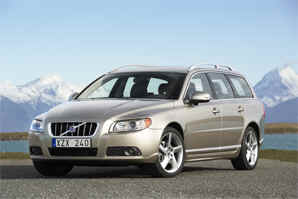
•
Maintaining leadership in the segment
•
Elevated combination of luxury and versatility
•
Target 75,000 cars per year
•
Sweden the largest market
•
Sales start in August 2007
•
World breakthrough in child safety
Backed
by 54 years of ongoing refinement and improvement, Volvo Cars
is still the global leader in the segment for large estate
cars.
Now
the all-new Volvo V70 is making its entry onto the market with
an innovative combination of luxury and versatility. “This
segment has been our specialty ever since we invented it back
in the 1950s. Our competitors can count on us remaining number
one in the future too. In the all-new V70, rear passengers and
luggage both ride in first class,” says Volvo Cars President
and CEO Fredrik Arp. More
The
new Volvo S40 and V50 – refined sportiness and increased
premium feel
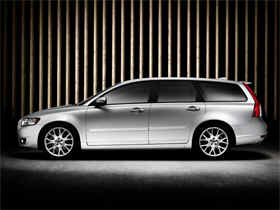
•
Closer visual links with the larger Volvo models
•
Increasing numbers of younger buyers with high premium demands
•
Improved storage
•
Enhanced driving pleasure
•
New safety features
•
Audio system of world class
•
One-third of total sales volume
When
the current generation of the Volvo S40 and V50 were
introduced in 2003, Volvo Cars had its sights firmly set on
younger buyers with high demands on sportiness and premium
feel. The
new Volvo S40 and new Volvo V50 are making a joint entry onto
the market with considerably refined design. A range of new
features further sharpens their competitive edge in the hunt
for discerning young car buyers. More
Insurance Institute for Highway Safety Acknowledges Volvo
C70's Safety Systems
The
Insurance Institute for Highway Safety recently conducted its
first crash tests of several convertibles and has awarded the
Volvo C70 as one of their 'Top Safety Picks'. "For
more than 80 years, Volvo has built cars with Safety in
mind," states Anne Bélec, President and CEO, Volvo Cars
of North America. "We are extremely pleased to have done
well in the Institutes' testing program. From the very start
of our modern convertible program, our goal was to bring
advanced technology and engineering skills into this flagship
vehicle."
The
hot-selling Volvo C70 arrived in the U.S. market in 2006 and
has set the benchmark for convertible safety in regards to
occupant protection with a number of safety systems, including
the unique Inflatable Curtain for side impact protection, the
use of multiple grades of steel for frontal and rear
collisions, and Volvo's Roll Over Protection System (ROPS).
More
ALL-NEW
VOLVO XC70: REFINING THE PACKAGE OF SUCCESS
When the first XC model from Swedish auto marque Volvo took to
the American roads in 1997, sales success and an entirely new
Cross Country segment soon followed.
Ten year later, the third-generation XC70 makes its North
American debut by rolling into the spotlight at the New York
International Auto Show. The original recipe is still
intact, but now Volvo's crossover vehicle has added luxury as
well as even greater capabilities for adventure.
The original XC exceeded Volvo's sales expectations largely
based on the vehicle's appeal to consumers in the United
States. For them, the XC70 served the functionality of
an SUV, while providing the distinctive Volvo feel of a true
premium car. The term "crossover" emerged. More
Volvo
quartet ranked as "best bets"
Nearly one quarter of Americans are considering buying a new
Toyota, while Ford is the top domestic manufacturer for brand
perception. Only five brands stand out from the competition
– Toyota, Ford, Honda, Volvo and Chevrolet.
The Car Book is considered to be the consumer’s best car
buying guide. In this year’s edition, which is the 27th, the
S40, V50, C70 (pictured), and V70 are all listed in the
“Best Bet” category. Story
GO
ON A SPRING BREAK TO SWEDEN
0NLY
$299 FOR FOUR* – BUT ONLY THE EARLY BIRD CAN CATCH THE
DEAL!
Buy your favorite Volvo now and enjoy our special Cruise
& Collect trip to the home of Volvo.
All
this is included – at an amazing $299 for four*:


Find
out how you can Catch the Easter
Deal!
Volvo
Car Military Sales IPOD Giveaway
Invites you to join in the exclusive music celebration
and take the opportunity to win a state of the art media
player. All you have to do is to answer the four
questions in our competition and you are a part of the
weekly draw. Just visit Volvo
Military Sales every Friday to find if you are the lucky
winner of the past week.
Top
Ratings for Volvo in latest JD Power Survey
On
the German market, Volvo gained the highest marks of all
European car manufacturers
in customer satisfaction. This is the result of the latest
"J.D.
Power-Report“,
the most important customer satisfaction study for the car
industry.
In
this survey, 126 car models of 28 brands were rated.
Volvo left all European cars behind - including the German
premium brands - and gained the forth rank behind
three Japanese car makes with an index-rating of 82.3%.
In
the upper-class category, the Volvo V70 gained the highest
scores and was ranked number one with an index of 82.3%. For
Volvo, customer satisfaction and permanent quality
optimization, as well as high quality of production, safety
and generally a strict focus on customer requirements have
always been the highest principles.
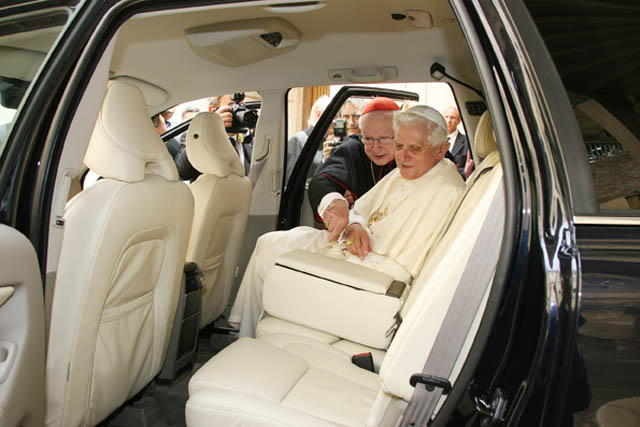
A
Volvo XC90 for Pope Benedict XVI
Volvo Cars presented His Holiness, Pope Benedict XVI,
with one of its Sport Utility Vehicles.
The keys of the car have been delivered to the Pope in the
Vatican, on Wednesday June 28th, with a short ceremony after
the Papal Audience.
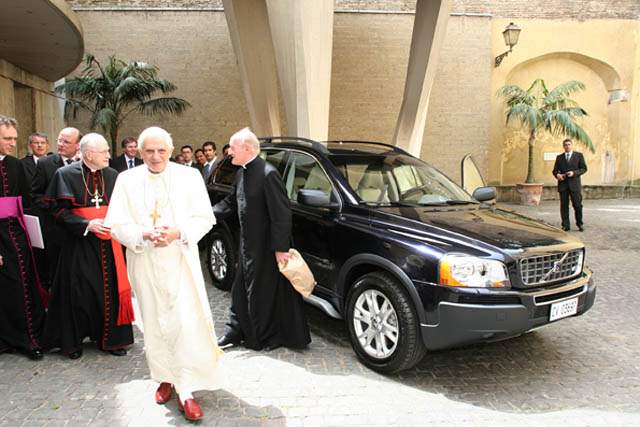
On Wednesday June 28, His Holiness Pope Benedict XVI has received the
keys of the Volvo XC90 that Volvo Car Corporation has
presented him with.
The delivery of the keys to the Pope has taken place in the
Vatican, during a short ceremony after the Papal Audience.
To represent Volvo Cars, Gerry Keaney, Vice President Volvo
Car Corporation, Marketing Sales and Service, Pascal Bellemans,
President Volvo Auto Italia, and Michele Crisci, General
Manager Volvo Auto Italia attended.
The Volvo XC90 delivered to the Pope – and fitted for His personal use
– is a V8 version. It is a dark blue XC90 with light
interiors.
Since its debut, the Volvo XC90 has set the highest standards among SUV
when it comes to Safety, in all driving conditions and on any
surface. The AWD system (all-wheel drive) allows the car
excellent off-road behavior, while ROPS System helps the car
avoiding roll-over or reducing consequences of that type of
accident.
The Volvo XC90 has also been designed and built not only to protect
people on board, but also in order to enhance Safety
performances on other vehicles in case of impact.
"We are absolutely happy and proud of the opportunity we had to give
a car to the Pope. Safety has always been a no-compromise
must for Volvo; no doubt, our strong commitment to
safeguard lives could not get a higher and more touching
recognition", said Pascal Bellemans, President Volvo Auto
Italia.
High-tech
3.2-liter in-line six-cylinder engine finds its way into new
refined Volvo XC90
•
Refined and more car like design
•
Upgraded interior
•
Sharper powertrain range with new,
highly advanced 3.2-liter six-cylinder engine
•
Focus on driver control including new
Park Assist Camera
•
World-class audio system with Dynaudio
speakers and Dolby Pro Logic II
•
50 percent of total sales in the USA
The
new XC90 is intended to strengthen Volvo Cars’ position in a
SUV market that received the first XC90 generation with
standing ovations.
Continuing success
The Volvo XC90 is an enormous sales success for Volvo Cars.
Its original production volume of 50,000 units was
successively increased and in 2005, production of the XC90 in
the Swedish Torslanda factory approached 90,000 units.
The new, enhanced Volvo XC90 will start production in spring
2006. Story
Volvo
Safety, with Children in Mind
New
York (April, 2006) - For over 30 years, Volvo has developed
child safety systems to help protect its littlest passengers.
Throughout those years, Volvo held to the belief that safety
protection should be for all occupants, regardless of size or
age. While safety is paramount, Volvo also believes that
keeping children comfortable is in the best interest of
parents, as well as the children themselves.
The Beginning of Modern Child Safety
The
impetus for modern child safety was born in Sweden 1963. While
watching an American TV program, Bertil Aldman of Chalmers
University in Gothenburg noticed the position of the
astronauts in the Gemini space capsule. By lying on their
backs, in opposite direction to the force of acceleration,
they were better able to withstand the acceleration. Professor
Aldman believed that this principle could be applied to
protect a child in the event of a head-on collision. Story
High-tech
3.2-liter in-line six-cylinder engine finds its way into new
refined Volvo XC90
•
Refined and more car like design
•
Upgraded interior
•
Sharper powertrain range with new,
highly advanced 3.2-litre six-cylinder engine
•
Focus on driver control including new
Park Assist Camera
•
World-class audio system with Dynaudio
speakers and Dolby Pro Logic II
•
50 percent of total sales in the USA
The
new XC90 is intended to strengthen Volvo Cars’ position in a
SUV market that received the first XC90 generation with
standing ovations. Story
Volvo
Car Corporation, Accessories - Wireless hands-free function in
Volvo cars with Bluetooth® and a mobile telephone
• Automatic connection to the car’s
loudspeaker system
• The system recognizes up to four different telephones
• Easy to switch between hands-free and telephone
• Voice dialing promotes traffic safety
It
is now possible to connect a Bluetooth-capable mobile
telephone to a Volvo car’s audio and loud-speaker system –
totally wirelessly. With the help of the new accessory Volvo
Hands-free with Bluetooth®, a mobile telephone becomes an
integrated hands-free system with voice dialing.
Volvo
Hands-free with Bluetooth® can be fitted in most late-model
Volvo cars. The system consists of an electronic control
module, a module with function buttons, a dedicated microphone
located near the rear-view mirror, and the necessary wiring. The
mobile telephone used must be Bluetooth-capable. Once a paired
link has been set up with the car’s Bluetooth module,
the telephone is recognized and connected automatically when
the owner enters the car. Story
Volvo
Models Best in Interior Air Quality According to New Study
An independent survey carried out by the Ecology Center in
Detroit shows that the interiors of Volvo’s cars emit lower
levels of toxic substances than other car makes.
The Ecology Center recently
presented a study (Toxic at Any Speed: Chemicals in Cars &
the Need for Safe Alternatives) of the toxic chemicals used in
building car interiors. Flame retardant PBDE and phthalates,
whose main use is as a softener in plastics, were included in
the study. These chemical substances can migrate from plastics
and textiles, particularly at high temperatures. The car’s
occupants may thus be exposed to these substances, for
instance through the respiratory system. Certain types of
phthalates and flame retardants can for instance promote
genetic mutations and can subject car occupants to health
hazards. The survey reveals that the concentrations of PBDE in
dust and on the windscreen are up to five times higher than in
the homes of most people, and since many people today spend a
lot of time in their cars, car interiors thus have a
significant effect on human health. For
More
Volvo
iPod Adapter - Volvo opens up to iPod users
Now it
will be possible for iPod users to plug their entire music
archive into their Volvo’s audio system. Together with
supplier PhatNoise Inc and Apple, Volvo Cars has developed an
adapter kit for installation in the Volvo S80 from model year
1999 on and in the S60, V70 and XC70 from model year 2001.
iPod is the world's number one digital music
player and allows music lovers to carry their entire music
collection with them on the go.
Now with the Volvo iPod Adapter, they can play their music in
their Volvo.
Volvo
Seats Get Top Scores in 2006 Thatcham Whiplash Tests
Once again, Volvo has
achieved top scores in the latest, 2006 model year new car
whiplash ratings by the UK's Motor Insurance Repair Research
Centre in Thatcham¹ which conducted the tests on behalf of
the International Insurance Whiplash Prevention Group (IIWPG).
In
fact, Volvo was one of only two manufacturers to achieve top
'Good' scores for every model tested² thanks to its
supportive seats which have a fixed head restraint position to
ensure they are always in the correct position to offer the
best support, and the Volvo Whiplash Protection System (WHIPS)
that moves the entire backrest to absorb the impact during a
rear-end collision to help reduce the forces on the neck.
Story
Volvo
XC90 recommended by American Consumer Guide 2006
Volvo
XC90 has named Recommended in the Premium Midsize SUV category
by the American Consumer Guide 2006.
The
yearly consumer guide announces cars and trucks which
represent the best overall values in 16 model categories. The
2006 list has 45 vehicles ranked as Best Buys and the same
amount of vehicles as Recommended.
"We drive these vehicles as their owners would, on
highway trips, in stop-and-go city driving, for weekend
shopping," says Consumer Guide® Automotive Publisher
Frank Peiler.
"That helps us arrive at real world conclusions about
them. We also take into account such factors as reliability
records, fuel economy, and resale value before we announce a
Best Buy or Recommended award." Respected for its
experience and objectivity, Consumer Guide® Automotives staff
test drives more than 200 new vehicles annually. It divides
the automotive market into 16 classes based on vehicle type,
size, and price. The segments cover the hundreds of cars, SUVs, minivans, and pickup trucks on sale in the U.S.
From these, Consumer Guide® Automotive has selected 45 models
as 2006 Best Buys--the publication's highest accolade. A Best
Buy represents the finest balance of attributes within its
class.
The Volvo XC90 was
recommended by the Consumer Guide2006.
The all new Volvo C70 – both convertible and coupe!
It’s ready to take its place in the sun – the all new
Volvo C70. Which also doubles as a coupe! Thanks to a
unique three-piece retractable hardtop, customers of the
second-generation Volvo C70 can enjoy life without
compromise – whether the top is up or down.
“We’ve succeeded in creating an attractive convertible
which, at the mere touch of a button, converts into an equally
elegant coupe.
The customer gets two cars in one. Both with space for four
adults,” says Volvo Cars President and CEO Hans-Olov
Olsson.
Story
Volvo XC90 V8 – power and pleasure also in extreme winter
conditions
The new V8 model reinforces the
Volvo XC90’s position as one of the
most successful SUV models in the premium segment – and
the new XC90 V8 is comfortable in all driving conditions, no
matter if we are talking about hot deserts or the extreme
winter above the Polar Circle.
The entirely new power train combines power and pleasure
with a stable and predictable behavior also in the toughest
conditions
Volvo cars aims for environmental leadership in the premium
segment
Environmental care has top priority
• Volvo aims to be one of the environmental leaders in the
premium segment
• Innovative technology makes Volvo cars Clean Inside and Out
Environmental leadership means setting
priorities. Volvo has a tradition of environmental care, of
providing environmental alternatives today and of dedication
to future commitments. This holistic approach gives Volvo
Cars an excellent position in the quest for
environmental leadership in the future.
Volvo V50 Awarded Prestigious Golden Steering-Wheel Trophy
The Volvo V50 has been awarded the “Goldenes Lenkrad” (Golden
Steering-wheel), a trophy instituted by the German paper
“Bild am Sonntag”. This is the second time a Volvo has been
awarded the prestigious award
“This is a great honor and most rewarding for us”, said a
proud Hans-Olov Olsson, President and CEO of Volvo Car
Corporation at the prize giving ceremony in Berlin.
Volvo seat is benchmark for Whiplash Protection
All Volvo's car models tested by the International Insurance
Whiplash Prevention Group (IIWPG) were found in the best
class. Volvo Car Corporation was the only manufacturer to
have their entire range achieves the best class rating.
"We are very pleased that the Volvo cars have performed in
line with our expectations", says Ingrid Skogsmo, Safety
Director at Volvo Car Corporation." Tests only show a sliver
of what happens in real life. However, this is one of
several results that confirm Volvo has the right approach to
help reduce neck injuries in rear impacts."
All new Volvo S40 sees stars as it aces NHTSA side impact
crash test; Sales up over 29 Percent month-to-date
The crunch of steel and shattering glass can be one of the
most horrific memories of an automobile accident. Unless, of
course, the accident isn't really an accident; but instead a
highly structured test being conducted by the National
Highway Traffic Safety Administration (NHTSA). That was
exactly the case recently when NHTSA completed its side
impact protection test of the all-new Volvo S40 sport sedan.
The results: 5 stars for the driver; 5 stars for the
passenger. The highest rating the U.S. Government
organization grants to passenger vehicles.
New Volvo S40 Earned Top Results in 4 Crash-Tests
The all-new Volvo
S40 combines everything today's car buyer is looking for:
Not only exceptional value, vibrant design, style and
exhilarating driving characteristics, but also class-leading
safety.
Volvo Cars 'Best Manufacturer'
in New British Insurance Car Security Awards
Volvo Cars - "Best Manufacturer"
Volvo C70: 2nd in 'Convertible/Roadster' class
All-new Volvo S40 and V50, plus S40/V40 Classic: 2nd in
"Family car" class
Long Anticipated – Now Available: Jaguar /Land Rover
Military Sales Program
Overseas service life offers
experiences and benefits that most people back home can’t
even imagine, such as the Jaguar/ Land Rover Military Sales
program. It is a professional organization with
international networks and local outlets in Germany,
Iceland, Spain and UK.
All Jaguar/Land Rover
Military Sales dealerships are close-by US-Military bases in
the respective countries
Volvo US Military Sales offers convenience delivery
If a US Military customer buys a Volvo at an authorized
Volvo US Military agent close-by his base abroad, he can
chose between four delivery options:
1. Factory delivery in Sweden free of charge.
2. Direct shipment to an US Volvo dealer at
customer’s choice free of charge.
3. Delivery to the Volvo Military agent close-by
the base abroad, including 3 years Volvo Home Shipment to an
US Volvo dealer at customer’s choice.
4. Delivery to more than 50 official overseas
delivery centers.
The offer is valid when buying a Volvo from an authorized
Volvo US Military agent abroad.